No reward is necessary.
“Bragging rights” might be claimed if your
family is the competitive type.
BACK
TO TOP
For
Couples
SEXUAL COMPATIBILITY IS NOT JUST ABOUT SEX
Many married couples
love each other dearly but through the course of their
marriage may find that their sexual desires are not
always in sync. It is often temporary or it may be
the result of awkwardness in talking about sex. When
discomfort talking about sexual intimacy is a factor,
sometimes a prompt like this quiz can help a couple
be more open and honest about what increases their
pleasure and what does not.
Rate yourself and your
spouse on the following questions based on your degree
of satisfaction:
Not at all Satisfied
Sometimes Satisfied
Very
Satisfied
1
2
3
4
5
1. Are you satisfied with how your spouse expresses
affection for you during the day?
True lovemaking is a 24/7 endeavor.
It doesn’t just happen at night and in bed.
Acts of kindness and affection during the day can
build closeness and desire. Of course if you’ve
been a grouch during the day, it’s hard for
many spouses to quickly turn the mood around.
2. Are you satisfied that
your spouse cares for you above all others (even your
children) and would never do anything to intentionally
hurt you?
Lovemaking is an act of total self-giving
– no strings attached. If your spouse isn’t
confident of your total devotion, it’s hard
to be vulnerable and lay bare your insecurities about
your body, sexual prowess, or embarrassment. Let your
spouse know you cherish him/her.
3. Are you satisfied with
how you can talk about difficult subjects, not only
sex?
Being handsome or beautiful is
not essential to good sex. The most important sex
organ is the mind. It can overcome physical limitations.
Sharing your feelings honestly but gently with your
spouse can bring you closer and make your bond strong,
not just physically but also emotionally.
4. Are you satisfied with
the environment in which you have sexual relations?
Although sometimes it’s nice
to be spontaneous about where and how you have sexual
relations, it often builds desire to have a conducive
environment. Making the effort to create a private
space and a romantic atmosphere shows the priority
you give to each other.
5. Are you satisfied with
the frequency of how often you have sexual relations?
Frequency of sexual intercourse
often changes as we age. It is not unusual, however,
for spouses to differ on how often they want to have
intercourse. This can be a delicate balance to achieve.
It’s important to realize that the frequency
of intercourse is not a measure of love but may be
biologically based. (See Not
Tonight Honey for more on this.
6. Are you satisfied with who initiates your times
of sexual intimacy?
Don’t get in a rut. It’s
a turn on for your spouse to know that you want him
or her sexually.
7. Are you satisfied with
how you spend your time leading up to intercourse?
Expectation and creating an environment
conducive to lovemaking can make the experience fuller
for both of you.
8. Are you satisfied with
how your spouse touches you during love making?
Is there anything you would like
your spouse to do more of, less of, or new? Don’t
let shyness or “we’ve always done it this
way” limit your full expression of physical
love. Sometimes even small changes in your routine
can bring freshness to your physical intimacy. It’s
OK to be clumsy. Remember, you’ve put your total
trust in each other and this is private.
9. Are you satisfied with
the frequency with which you reach orgasm?
Although men almost always reach
orgasm, women’s response to sexual stimulation
can vary. Don’t be afraid to talk about how
you feel if you don’t have an orgasm and explore
if there are ways to increase the frequency of orgasm.
10. Are you satisfied with
the way you feel right after you make love to each
other?
Just as men often become sexually
aroused more quickly than women, so too men’s
passion wanes more quickly after ejaculation. Since
women’s arousal diminishes more slowly, attention
to this time of “after glow” can help
satisfy both partners more completely.
11. Are you satisfied with
the care your spouse takes of his/her body to make
yourselves appealing to each other?
Hygiene, weight, grooming, etc.
are both a matter of health and a sign that you care
enough about your spouse to put the effort to please
each other. It’s not a matter of objective looks
but how you look at each other. You honor your spouse
by honoring your own bodies, to be given to each other.
12. Are you satisfied with
the way you’ve decided to plan your family?
Sometimes concern about becoming
pregnant or methods to prevent pregnancy can interfere
with free and comfortable lovemaking. Family planning
is a decision you must make mutually and support each
other.
SCORING:
The most important part of this quiz is not your
final score but the discussion that it prompts between
you.
• Review the questions where you both marked
4 or 5 and rejoice that you are relatively satisfied
with the ways you’ve developed to express your
love sexually.
• Review the questions where you differed by
more than 2 points and discuss what might cause those
differences.
• Review those questions in which one or both
of you marked 1 or 2. In a private, gentle way, discuss
what you might do to increase your satisfaction.
Self:____ Spouse:____
Remember that each sexual relationship is unique.
You are not comparing yourselves to what the media
portrays as normal or what your friends imply they
do. What’s important is that you are satisfied
with each other and trying to please each other as
much as possible. For inspiration you might want to
read The Song of Songs from the Bible. You might be
surprised how much scripture honors the beauty of
the human body and the passion of loving spouses yearning
for each other physically. Christians believe that
God is a partner in the creation of human life, “and
indeed it is very good.” (Genesis 1:31)
BACK
TO TOP
For
Families
IS YOUR CHILD BORED?
After the excitement of
summer vacation begins to wear off, a frequent complaint
from children is, "I'm bored."
What's a busy parent to do? One solution is to check
out the "Summer
Job Jar" listed above because a bored child
can certainly be called upon to help out with household
chores. If it's too late in the summer to set up such
a routine, (or if you're already doing the job jar)
another option is to offer a Reading Challenge.
(No video games please.) Here's how it could work:
Challenge your childre
to read _x_ minutes a day (5 minutes for
every year might be a guideline, thus a 10 year old
would read for 50 minutes). A trip to the library
could kick start your challenge. In fact many libraries
have programs like this that you might want to attend.
Use some kind of chart
to keep track of your child's reading and agree upon
a goal of how many minutes/hours are reasonable for
your child to shoot for until school begins.
Agree upon a reward for
reaching the goal, but also agree that time will be
subtracted for each time he or she complains, "I'm
bored."
Let your child see your
own enjoyment of reading throughout the summer too.
This gives both of you some down time and can jump
start some interesting conversations.
BACK
TO TOP
For
Couples
ARE WE INTELLECTUALLY COMPATIBLE?
Couples don’t have
to have similar IQ’s or educational degrees
in order to be intellectually compatible, but if one
values the life of the mind and the other would rather
just vegetate, it decreases satisfying couple conversation
– the heart of intimacy.
Circle the response
(Agree, Both, Disagree, or Unsure) that best fits
you.
1. I like to play games that stretch my mind (cards,
Scrabble, Boggle, Trivial Pursuit, puzzles…)
more than games that are based mostly on luck (Twister,
Bunco, The Ungame, Bingo…)
Agree
Both
Disagree
Unsure
2. I like to read and listen
to public radio more than to do physical activity.
Agree
Both
Disagree
Unsure
3. I like to attend cultural
events (plays, operas, museums) more than popular
movies or concerts.
Agree
Both
Disagree
Unsure
4. I prefer classical and
jazz music to rap, pop or easy listening music.
Agree
Both
Disagree
Unsure
5. I like analyzing/talking
about a book, movie, or play rather than just enjoying
it and letting it go.
Agree
Both
Disagree
Unsure
6. I read for recreation
more than information.
Agree
Both
Disagree
Unsure
7. When my spouse* and
I play intellectual games, we’re usually pretty
evenly matched.
Agree
Both
Disagree
Unsure
8. I know enough about
my spouse’s work that I can listen sympathetically
and understand the basics.
Agree
Both
Disagree
Unsure
9. I feel comfortable socializing
with my spouse’s work colleagues.
Agree
Both
Disagree
Unsure
10. I’m decent at
reading maps and can find my way around a strange
city.
Agree
Both
Disagree
Unsure
11. When assembling a toy,
piece of furniture, etc., I can usually do it in a
reasonable time, without any parts left over, and
without cursing.
Agree
Both
Disagree
Unsure
Bonus Questions:
12. I know how to defrag a hard drive, get my e-mail
remotely, use my cell phone for more than phone calls
and photos, and network home computers.
Yes to all 4
3 out of 4
2 out of 4
1 out of 4
none
13. I know how to tell
the difference between:
A.
a cherry tomato and a grape tomato
B.
an allemande and a gypsy
C.
a stallion and a gelding
D.
a V6 engine and a straight 6
E.
a sonnet and an epic
F.
Advent and Lent
G.
a child’s moody cry and a crisis cry
H.
a fact and a feeling
SCORING:
On questions 1 – 11 if you:
• Both circled Agree on
most statements, you have a compatible Classic style
of intelligence.
• Both circled Both on most
statements, you are a couple for all seasons, very
eclectic.
• Both circled Disagree
on most statements traditional intellectual pursuits
are not important to you.
This has nothing to do with how smart you are but
rather your intellectual tastes.
Of course
it could also mean that you are so laid back that
you might want to take your pulse.
• Both circled Unsure on most
statements, you have trouble making up your mind or
making decisions.
This is a marital concern of a different kind but
can be equally annoying.
• Disagree with each other on five or
more responses, you may feel disappointed or irritated
with each
other’s intellectual style. One of you needs
to lighten up and the other tighten up on intellectual
pursuits lest you succumb to IDD (Intellectual Deficit
Disorder).
• Disagree on #10 or #11, that’s
fine. You can make up for the other’s deficit
as long as you don’t
gloat.
On Bonus Questions,
#12 and #13:
Questions #12 and #13 point to different kinds of
intelligence beyond traditional styles. See who has
technical intelligence or:
A. food/gardening intelligence
B. dancing intelligence
C. animal intelligence
D. automotive intelligence
E. poetry intelligence
F. religious intelligence
G. parental intelligence
H. relationship/communication intelligence
*The term spouse
is used for simplicity. If you are dating or engaged
just substitute boy/girl friend or fiancé/fiancée.
BACK
TO TOP
For
Families
DOES YOUR CHILD HAVE NDD?
(Nature Deficit Disorder)
Reading to children
is good. Academic teams are good. Teaching our children
good nutrition, self-discipline, and delayed gratification
is important. BUT, sometimes we just have to encourage
them to get outside and play. Richard Louv originally
coined NDD (Nature Deficit Disorder) in his book Last
Child in the Woods. Is your child at risk?
Take the VOGT NDD quiz
below. Although you may have to adapt it to fit the
age of your child, consider whether your child (and
your whole family) can do the following:
1. Does
your child get outside for free play at least a half
an hour a day?
2. If your child is of school age, can he or she identify:
• one bird (other than a
robin),
• one leaf (other than a
maple),
• one rock (other than a gem
stone), and
• an insect (other than
an ant or spider)?
3. Has your child ever made mud pies, sand castles,
or a fort in the woods?
4. Can your child go a day without using an electronic
gadget (phone, computer, video game…)?
5. Does your family ever go hiking in the woods? (At
least once a season is good.)
6. Has your family ever camped – in a tent,
not a motor home?
7. Does your child know how to safely make a campfire
(without an igniting fluid)?
8. Has your child ever grown something from a seed?
9. Have you ever laid on the ground and tried to
identify stars with your child?
10. Can your child identify poison ivy and poisonous
snakes?
Bonus:
Can YOU do all of the above?
A resource: No
Child Left Inside is a national movement that
encourages environmental education.
An activity: Why not try a Nature
Scavenger Hunt. It could be a birthday,
sleep over game, or just a fun family activity.
Create a
list of simple outdoor objects from nature. Invite
the neighbor kids to form teams.
BACK
TO TOP
For
Couples
WHEN YOUR HONEY IS FAR AWAY
It’s hard to
stay connected with your beloved when you are separated
by distance for a long time. “Long” may
range from a week or two of out of town work to many
months or a year in the case of military deployments
or immigration difficulties. Following are some ideas
gleaned from a creative newly married couple who have
been separated for months while he worked in in Iraq
and she in Florida.*
SKYPE DATES:
You will need: a lap top computer and internet connection.
Start with a theme and then just work with whatever
you have. Once a week is nice but long distance relationships
are subject to local conditions so you may have to
be flexible.
Hints from Mary Jane: “Two ways to make
it special are to put something special in the background
and to wear a special outfit. Music is good if it
doesn't interfere with the conversation, or if it's
a time to enjoy it together. Ladies, remember that
guys are very visual and it's OK to look attractive.
People may have different thoughts about how modest
to be over the internet, but I think bathing suits
and nightgowns are very appropriate. Dean likes it
when I take one of the clips out of my hair.”
Here are some ideas to get you started
Beach Party:
Props: umbrella, beach towel, small cooler,
picnic items. Wear your bathing suits.
Camping Trip: Props: sleeping bag,
backpack, small Coleman burner, marshmallows, etc.
Wear a flannel shirt or pajamas. Sing campfire songs
Nature Walk: Location: On a deck,
porch, or the yard is nice – as far as the wifi
signal will reach. Props: collect samples of different
foliage, or potted plants, or flowers. Discuss landscaping,
likes/dislikes, nature facts, biology, etc.
Birthday Party: Props: balloons,
cupcakes, candles, etc
Japanese Tea Garden: This was a "dinner
date." I (Mary Jane) dressed up and pulled my
hair back. I picked up sushi and decorated the backdrop
with oriental looking flowers (silk from Hobby Lobby).
Fashion Show: Props: runway music
in background, different "collections" (formal,
business casual, Christmas, swimsuit, lingerie –
if you dare). Dean modeled his suits with different
ties, and a few shirts.
Kitchen/Cooking: Set laptop in the
kitchen as you cook.
Library: Prop: bookshelf in the background
if possible. Preparation: go to the library and pick
out a few books that interest you, then discuss them.
Gym/Sport: Props: wear your exercise
clothes and go through a set of stretches and exercises
together
GOOD MORNING
EMAILS:
Because separation by distance often also means separate
time zones, one spouse can write a “Goodnight
Email” which becomes a “Good Morning Email”
for the other. It could become a daily or weekly ritual
depending on your circumstances. Mary Jane says, “I
usually write something romantic like in the biblical
Song of Songs. We are still newlyweds so there is
a lot of fire in our romance, but being apart, these
regular words add fun, excitement, and anticipation."
QUICKIE FYI
EMAILS
“When I can think of something really brief
when I first get up, I'll send Dean an FYI email.
FYI is the subject line. It goes to his business e-mail
so that he knows that I'm awake. It is brief since
it is interrupting his work day. It can be "suggestive"
but somewhat covert. We have acronyms like WYWH, for
wish you were here.” For example:
• "I just woke up dreaming that I was waking
up with you. I think I'll go back and finish dreaming."
• "You are one handsome, dude, young man.
(just thinking about our last G-chat)"
• "I'm ready to go back to bed. How about
you?"
• "I miss you. I want to wrap my arms around
you."
• "Hi, my name's Mary Jane. Can Dean come
out to play today?"
MISCELLANEOUS
Try reading and praying together. Take turns doing
it live on Skype or share emails about your reflection
on a book you’re both reading or a prayer.
*Thanks
to Mary Jane and Dean Sinclair for most of these ideas.
PS: Some of the
general principles of Skype dates could apply to keeping
in touch with far flung children or grandchildren
too.
BACK
TO TOP
For
Families
CAN
YOU EAT ON $4.50 (or $6.25) a DAY?
In 2011, $4.50/day
(or $31.50/wk.) was the average food stamp allotment
for
about 49
million
Americans. (Update: in 2024, it is approximately
$6.25/day accounting for inflation) Could you do
either amount? I’m
pretty frugal and my husband (who does the cooking
in our
family)
is a careful and health conscious grocery shopper.
We decided to try to do it as part of the Food
Stamp Challenge. I am passing the
challenge on to my readers. We’re going to
start on Ash Wednesday, Feb. 22, 2012. Our goal
is to do
it for all of Lent, but I’m not willing to
sacrifice my health for an awareness raising experience.
It
may be that we only do it for a week if we find it
insane and unhealthy to continue. Here are some
preliminary
questions that we will need to address:
1. Can we supplement with food that we already
have stored in the house?
Hmmm, probably not (or only minimally
with staples like flour, sugar, and salt), if it is
to be a true experience.
2. What about eating out?
That would probably blow the budget
in one meal.
3. What if people bring us food, invite us
over for dinner, or offer a snack at a meeting?
We’ll have to find a way
to calculate that in.
4. What about eating while traveling?
Eating is so much less expensive
when you cook it at home.
5. What about economy of scale?
Cooking for two means we have
$9/day to spend. Cooking for six means we have
$27. Food goes further when you can buy in bulk.
Lent may be too long. Heck, we may find that one week
is too long – or too complicated to keep track
of food expenditures. For an ordinary family it may
be enough to try it for one day. Whatever you do,
it will be enough if your heart and wallet become
more open to the reality of our fellow Americans –
and those are just our neighbors close to home. Let
me know if you try it.
Follow my blog
or Twitter
for weekly (sometimes daily) updates starting February
15.
BACK
TO TOP
For
Couples
DO
YOU OPERATE IN DIFFERENT MARITAL TIME ZONES?
1. When I’m
behind a slower driver:
A. I relax. I’m in no hurry
B. I feel sympathetic since I assume
the driver is elderly, cautious, or lost.
C. I feel irritated and pass as quickly
as I can, even on the right side.
2. When leaving
for a party:
A. I’m relaxed but I’m
also late. It doesn’t bother me. Does it bother
others? That’s their problem. Life’s too
short to hurry.
B. I’m always ready ahead of
time and leave 5-10 minutes early in case there’s
heavy traffic or bad weather.
C. I’m more or less ready when
we agreed to leave but in no hurry since parties are
not meant to start at a precise time. (Let’s
assume this is not a surprise party.)
D. I have good intentions to leave
on time, but generally find myself scurrying around
at the last minute while my spouse waits impatiently
at the door (or worse, in the car).
E. Both of us are frantically racing
at the last minute and our friends have taken to telling
us parties start an hour before the actual time.
3. When watching TV or some other mindless
activity:
A. I relax and enjoy the down time.
B. I schedule screen time so it
doesn’t interfere with work or other priorities.
C. I make sure I can multitask
(fold laundry, nurse a baby, knit, etc.) at the
same time.
D. I never watch scheduled TV.
I tape or TIVO everything so I can skip thru commercials.
When I do watch TV I multitask and check e-mail
during the slow parts.
4. When on a car trip, but not doing the
driving:
A. I chat and enjoy the scenery.
B. I nap to prevent being tired
later.
C. I’m busy taking care of
children’s needs or navigating for the driver.
D. I make cell phone calls, work
on my laptop, check traffic reports, or listen to
NPR to maximize my time.
E. I do almost all of the “D”
items at the same time.
5. When leaving
to catch a plane:
A. I pack the night before, leave
plenty of time to get to the airport (accounting for
the possibility of an unseasonable blizzard in July),
and plan to arrive more than one hour before flight
time.
B. My philosophy is JIT (just in
time). I calculate when I need to leave for the airport
in order to be there one hour ahead of time. (Glitches
hardly ever happen anyway and I don’t like to
waste time waiting.)
C. I’m usually hectically gathering
my stuff and doing last minute chores until I must
leave. Then I search for my car keys, call my cell
phone to find out where I last put it (It vibrates
in my pocket.) and rush to the airport.
D. I consider being at the airport
an hour early a waste of valuable time. Sure, I cut
it close and have been known to miss a flight, but
life is an adventure. When on the plane, I always
have my trusty laptop to catch up on work.
6. When waiting
in line (at the supermarket, the bank, a bus stop
or metro, etc.)
A. I’m bored.
B. I’m fine. I figure waiting
time is praying time.
C. I fidget and feel annoyed with
people who dally, chit chat, or have more than 10
items in the quick checkout line.
D. I try to calculate the fastest
line, switch back and forth if necessary or just leave
and decide to do my errands at a less busy time.
SCORING:
A answers = 1 point
B answers = 2 points
C answers = 3 points
D answers = 4 points
E answers = 5 points
6-12 points:
You’re either very laid back or very cautious.
Unless your spouse has a similar style, you may be
causing each other stress. Look for compromises.
13-19 points: Your timing may not
always be perfect, but at least you’re in the
sane and practical range.
20-25 points: Whoa! If not headed
for a heart attack, you’re at least headed to
stress your spouse and miss smelling the roses. If
your spouse has a significantly lower score, you might
also head for counseling.
*The
term spouse is used for simplicity. If you are dating
or engaged just substitute boy/girl friend or fiancé/fiancée.
BACK TO TOP
For
Families
TECHNOLOGY
TIPS FOR FAMILIES
Technology like computers,
cell phones, and other electronic devices can be both
a blessing and a curse. How you use these modern conveniences
is a challenge for families and requires honest discussion
and family rules. Following are issues that parents
and children should talk about in designing your family’s
unique policy for using technology.
1. Computer Time limits
Computers and the internet can certainly help with
school or jobs. Too much recreational time looking
at a screen, however, robs us of human interaction,
physical activity, and contemplation that are good
for mind, body, and soul.
2. Computer location
Computers that children use should be in a common
area – not their bedrooms.
3. Social networking (Facebook, Twitter,
blogging, Linked In, etc.)
• The minimum age to be on Facebook is 13. (You
can lie about your age but remember that others may
be lying about who they are too.)
• Anonymity can prompt people to lie and be
ruder than they would be in person.
• Think before you post. Would you want your
grandmother, a college admissions officer, or a future
employer to read it? You can’t take it back.
• Is social networking depriving you of face-to-face
human interaction? A computer can’t hug you
back.
• Don’t play with strangers. Children
should know not to give out identifying information
(name, age, address, school, etc.)
• Parents, help your child set up any social
networking site, be your child’s “First
Friend. Insist on knowing any passwords. Periodically
check in.
4. Cell phones can be a valuable safety tool
and are great for keeping in touch, BUT families need
to decide:
• At what age should a child be allowed to get
a cell phone for calls/texting?
• Data plans (like those on smart phones) are
not appropriate for children. It’s not necessary
for safety.
• Who pays for the phone?
• Talking on the phone or playing games should
not trump the live people around you. No phones at
meals, while having a face-to-face conversation, or
after bedtime.
5. Everything else (TVs, DVDs, video games,
movies, music)
The rule of thumb for use of most technology it that
it should:
• Be respectful
• Not substitute for healthy human interaction
• Not be a time hog
• Not pre-empt outdoor or physical activity
• Not break the bank
Note to parents:
The bottom line for healthy use of technology in the
family is that you have to know your child. Some children
need strict rules while others have earned your trust
over the years. Educate your child about the dangers
of the internet and be a partner with your child in
developing family rules. Become tech savvy enough
yourself that you know how to set “Parental
Controls,” know how to check website history,
and use a filter if warranted. No technology, however,
can substitute for a healthy relationship with your
child. Kids can get around anything if they really
want to. Check www.netsmartz.org
for more depth. Click
here for a handy handout for parental reflection.
BACK
TO TOP
For
Couples
I'M
DREAMING OF A STRESS-LESS CHRISTMAS
The time leading up
to Christmas (Advent) can be a time of reflectiveness
and joy, but our expectations (and those of our family
and culture) can also leave us physically stressed,
emotionally exhausted, and in adversarial relationships
with the ones we love most. With some forethought, however,
couples can minimize stress and experience the time
both before and after Christmas as a time for strengthening
family relationships.
Consider the following suggestions, then talk to your
spouse and agree on a plan. Keep expectations realistic.
What limits do you want to set on the time, money, and
energy you spend?
1. Invite other family members to participate
in decisions affecting them? (For example, don’t
just declare that this year we’ll draw names for
gift-giving or presume that everyone will gather at
your home for the main Christmas meal.
2. Which Christmas rituals from your family
of origin do you want to continue? Which from
your spouse’s family? Are there new ones you’d
like to create?
3. List two things you could do to make your
spouse feel less stressed and more loved.
4. What gift would your spouse really appreciate?
It need not cost money. Perhaps a gift of time (like
a coupon to teach computer skills or take over a dreaded
chore) would me more meaningful than another sweater.
Best to agree that you’re both going to do a “creative
gift” ahead of time, however, lest it backfire.
5. Are there any holiday triggers that
have caused problems in the past? Consider overuse of
alcohol, feeling pressure to prepare a special meal,
keep the house clean, put up decorations, money worries.
Share the concern and plan a way to deal with the potential
problem.
6. Share the burden of preparing for
Christmas. Which jobs do each of you like to do? Which
do neither of you like doing? Can some be eliminated
and the others shared.
7. Is there a lonely person you could
invite to share the season with you?
8. If you visit relatives, what behavior patterns
that cause stress should be avoided?
9. Decide how much money you want to
spend on gifts and celebrating. In the true spirit of
Christmas, consider making one of your gifts a donation
to a worthy cause. (For example, our own family has
decided to sponsor a partial scholarship to those graduating
from our children’s high school.)
10. Give yourself a time-out. It may
be a quiet evening when you agree not to talk about
Christmas preparations and just rest in the Advent season
of waiting, or simply a pause before dinner when you
light an Advent candle and sit in the dark for a moment.
BACK TO TOP
For
Parents
DEALING
WITH FEARS
Fears, anger, and feeling
overwhelmed are negative emotions that can paralyze
both adults and children. First, consider whether the
fear is imaginary or real.
1. Imaginary or exaggerated fears
If it is simply your imagination stirring up fantasy
fears or unfounded anger, talk yourself down
from your emotional overkill.
• “This is not likely to happen and I can’t
do anything to change it anyway.” Repeat.
• Then force yourself to think of something else
that’s happier or takes some mental energy like
solving a computer problem, practicing a foreign language,
praying.
• Give children factual information and a comfort
toy to focus on. For example, if they are afraid of
the dark use a night light.
• Sometimes it helps to exaggerate the fear so
that it is comical and everyone can laugh at it.
2. Real fears and justified anger
If it is a fear grounded in reality or an anger prompted
by a genuine injustice, take action.
• Taking an action step to fix a problem helps
us feel more in control. For example, if you’re
afraid that global warming will damage the environment
for your children’s children, get involved in
an advocacy group or at least recycle and drive a fuel
efficient car. If you are angry at a politician, work
for a candidate you can support or at least donate some
money. If you are afraid of economic insecurity, reduce
your consumption and structure your job search so you
are doing at least one action toward getting a job each
day
• If children are afraid of a bully, help them
learn self-defense. This might be learning to talk their
way out of a dangerous situation, building self-confidence
by taking a martial arts class, changing a friendship
group, or rearranging the route to school. Talking to
school officials about a serious problem can show your
child you care and that others are on their side.
• If children are afraid of generalized violence
like terrorism, assure them that such extreme dangers
are rare, BUT if some tragedy would happen you have
confidence that they have the courage inside them to
face it. Then point out to them small times they have
acted courageously and that you have confidence that
your family could recover.
3. Fear and anger can be our friends
– not welcome friends, but necessary ones. Often
these emotions alert us to bad situations that need
to be faced and not just avoided. ACTION is the best
antidote.
4. “In the
face of escalating violence, let us escalate love.”
Our friend, Jim McGinnis coined this phrase
as a way to deal with the evil, fear, and problems that
surround us. They are good words to live and die by.
BACK
TO TOP
For
Families
LIVING
WITH LESS - BUT ENJOYING IT MORE
1. What is your most prized
non-human possession?
2. How does it bring you
joy?
3. Be grateful
4. What’s your spending
personality?
Frugal
Spendthrift
1
2
3 4
5
6 7
8 9
10
Thoughts to ponder:
We make ourselves rich by making our wants few.
–Henry David Thoreau
We’ve discovered
that owning things and consuming things does not satisfy
our longing for meaning. –Jimmy Carter, 1979
If you keep your food in a refrigerator, your
clothes in a closet; if you have a bed to sleep in,
and a roof over your head, you are richer than 75% of
the people in the world” –The
Miniature Earth.
When someone steals another’s clothes we call
him a thief. Would we not give the same name to one
who could clothe the naked and does not? The bread in
your cupboard belongs to the hungry; The coat hanging
unused in your closet belongs to the person who needs
it; The shoes rotting in your closet belong to the person
who has no shoes; The money which you hoard up belongs
to the poor. –St. Basil the Great, Bishop of Caesarea,
c. 365
Decision Time
1. What can I (we) live without?
Car Washer/Dryer A/C
Microwave TV Computer
Cell Phone Dishwasher
Other
2. Is it better to save the earth or to save money?
What would you be willing to pay a higher
price for because it’s better for humanity or
the earth?
3. Is there one thing I am willing to give away this
week because someone else needs it more than I do?
___________________________
4. Would any (all) of us be willing to limit our spending
for a day, week, or month (or during Lent) to
help people who have less than us?
If so, how will we do it and what cause
will we give the money to?
Resources on consumerism
• Surviving Hard Economic Times by Jim
& Susan Vogt. Email susanvogt1@gmail.com for revised
text.
• Click
here for Money in the
Kingdom of God by Susan Vogt, Bible study.
BACK
TO TOP
For
Couples
COUPLE'S
SCAVENGER HUNT
Home based for one
couple:
1. Something alive, besides you
2. Something hidden
3. A book or pamphlet on
marriage
4. A plant that needs water
5. A word of wisdom
He: ___________________________________________________________________
She: ___________________________________________________________________
6. Something new about my
spouse that I didn't know before:
He: ___________________________________________________________________
She:___________________________________________________________________
7. A fond memory of a special
time together:
He: ____________________________________________________________________
She ____________________________________________________________________
8. A scripture about love
or marriage (The Biblically challenged may want to Google
marriage/scripture.)
He: _____________________________________________________________________
She _____________________________________________________________________
9. A wedding memory
He: _____________________________________________________________________
She: _____________________________________________________________________
Community based for a group of couples:
1. Something from a favorite date place
2. Water (to refresh &
renew you) in an earth friendly reusable container
3. A snack (or insight about
marriage) to share when you get back to Scavenger Central
4. Something from nature
that reminds you of your love
5. Sporting equipment from
an activity that you enjoy doing together
6. Find a cemetery. Walk
through it. Note name & date of a tombstone. ______________
7. A scripture about love
or marriage (The Biblically challenged may want to Google
marriage/scripture.)
8. A book or pamphlet on
marriage.
BACK
TO TOP
For
Couples
3
THINGS EXERCISE
A super easy way to take
stock of your marriage
Respond
to the questions below individually and then discuss
your responses with your spouse. Be honest and “speak
for yourself.” Don’t presume what your partner
will say or try to guess the "best" answer.
This isn’t a guessing game but a chance to take
yet another step toward deepening conversation and growth
in your marriage. Writing your thoughts down helps.
1. Three things about my marriage that I like very much:
2. Three things about my marriage that I think could
be better:
3. Three specific things that I personally could do
to improve our relationship:
With permission from: Better Marriages,
P. O. Box 21374, Winston-Salem, NC 27120 • Phone
336-724-1526 • www.bettermarriages.org ©
Copyright
BACK
TO TOP
For
Families
NEW
YEAR'S PEACE (and Quiet?)
Adapted from Just
Family Nights
By the
time New Year's Eve comes many families welcome the
opportunity to stay at home and relax from hectic holiday
activities. This Family Night may take place on New
Year's Eve as an alternative to going out to parties.
New Year's Eve also provides a longer stretch of time
for the "game-a-rama" option. New Year's Day,
or another time within the holiday vacation time, would
also work.
PREPARATION:
1. Book Option:
• Pens, pencils, crayons, or markers
• Six sheets of paper for each family member (to
make a booklet) Put one of the following statements
on each paper.
#1 The happiest time for me during this past year
was...
#2 A regret (sadness) about something I did last
year is...
#3 One way I could be more at peace with myself
during this next year is...
#4 One way I could be more at peace with my family
during this next year is...
#5 One way our family could be a peacemaker in
our neighborhood this next year is...
#6 One way our family could contribute to world
peace this next year is...
• Stapler or hole punch
2. Countdown Option:
• Calculate the beginning time based on 3, 6,
or 12 hours before midnight.
• Sheets #1 and #2 from above
• 12 slips of paper with a different month on
each, i.e. sticky notes
• Noisemakers (bells, whistles, pots and pans,
etc.)
3. Game-a-Rama Option:
• Sheets #1 and #2 from above
• Each family member chooses a game or activity
for the family.
OPENING:
Gather around a table. Light a candle as a reminder
of God's presence and to emphasize the specialness of
the time together. The leader then passes out the first
two prepared sheets of paper and asks each member to
think silently about how they would answer these two
questions.
Next, ask each person to write or draw their response
on the appropriate sheet. Discuss your responses briefly.
Choose one or more of
the following:
1. BOOK OPTION
We've just finished remembering some good and difficult
things about the year we are leaving behind, now we
turn to greet the new year. Often people make promises
(resolutions) about ways they want to become better
people at this time of year. Also, often, these promises
are quickly forgotten because change is hard. Tonight
we're each going to make a personal book of resolutions
for the new year. Having something on paper will help
us remember our promises. Also, some of the resolutions
may be actions that our family does together, so we'll
be able to help each other.
Although resolutions could be about anything that would
make each of us a better person. New Year's Day is also
widely celebrated as a day of prayer for world peace.
This year, let's focus our promises on peace.
Reading:
Colossians 4:12-15 or Colossians 3:10
Family Response:
• Pass out sheets #3 and #4. Give a brief example,
then have members write or draw the resolutions they
want to make for #3 and #4 on the appropriate sheets.
• Pass out sheets #5 and #6. Give a brief example,
then have members write or draw the resolutions they
want to make for #5 and #6 on the appropriate sheets.
After discussion, hopefully the family can decide on
joint actions for #5 and #6. Decide what steps it would
take to carry out your decision and when you can do
it.
• Combine your sheets to make a book for each
person. Staple or punch holes to attach pages. Make
a cover and decorate it with symbols of peace (doves,
rainbows, etc.) Agree on a place in your home to display
the books so that they can be a reminder of your resolutions.
NOTE TO LEADER: Since resolutions,
by their nature, are often well intentioned but easy
to forget, follow-up is helpful. Perhaps the first day
of each month at a common meal could be a handy time
to check in with each other about how the family is
moving toward fulfilling the resolutions.
2. COUNTDOWN OPTION
Tonight we're going to use noise as a way to call us
to remember important events that happened to our family
during this past year. Noise is often seen as the opposite
of peace as in, "I want some peace and quiet."
Noise need not always be negative, however. Tonight,
we'll make some joyful and happy noises of remembering.
This option needs the Family
Night to span at least three (and up to twelve) hours.
Put sticky notes marking the 12 months of the year next
to each hour on a clock. (If done in an abbreviated
form, every 15 or 30 minutes could equal a month.) Choose
a family member for each month. At the appointed time
on the clock, the "January person" rings their
noisemaker and calls everyone to interrupt whatever
they are doing to come to a central spot. The family
then calls to mind significant things that happened
to them during that month. (Have the family calendar
handy to prompt memories.) When this reminiscing has
run its course, family members return to whatever they
were doing until the next month's noisemaker calls them
back. If the family will be staying up late, plan the
intervals so that December's noisemaker rings at midnight.
3. GAME-A-RAMA OPTION
Decide how much time the family wants to spend playing
together. Divide this time by the number of people in
the family. Each person then gets to choose a game or
activity they would like the family to do during their
portion of the time. Agree that no request is too silly
or dumb and that everyone home will participate. If
this "game-a-rama" goes until midnight on
New Year's Eve, celebrate with noisemakers. Sing "Auld
Lang Syne" if your family is the nostalgic kind.
BACK
TO TOP
For
Couples
HOW
WELL DO YOU KNOW YOUR SPOUSE'S PAST?
Do you know your
spouse’s:*
1. Mother’s maiden name?
2. Favorite pet as a child?
3. Names of three high school friends?
4. Name of first boyfriend or girlfriend (who of course
was not nearly as attractive, intelligent,
and funny as you)?
5. Siblings’ birthdays?
6. Parents typically handled disagreements?
7. Favorite childhood TV program or movie?
8. Award(s) received in grade school or high school?
9. Way of being disciplined as a child?
10. Mode of transportation to elementary school? (bus,
car pool, parents, home schooled…)
11. Allowance as a child and what it covered?
12. Way of learning about sex as a child?
13. First memorized prayer?
14. Opinion about his/her religious education or lack
thereof?
15. Favorite childhood hero or saint?
16. Family’s black sheep and why?
17. Grandparents’ cause of death? (or great grandparents'
if more appropriate)
18. Family’s medical history, especially diseases
that have genetic roots?
19. Favorite childhood book?
20. Favorite teacher? Why?
*The
term spouse is used for simplicity. If you are dating
or engaged, substitute boy/girl friend or fiancé/fiancée.
Although it can be fun to
check how well you know trivia about your spouse’s
past, knowing about your spouse’s family of origin
(parents, siblings, relatives) can also be serious stuff.
It can give you insight as to why he or she has certain
habits or strong belief’s. The past does not determine
the future but it can help you understand the present,
and perhaps shorten some arguments.
SCORING:
15-20 correct: You probably know your spouse well and
have open communication about life.
10-14 correct: Have a relaxing evening catching up on
the past and reminiscing.
5- 9 correct: What HAVE you been talking about? Maybe
it’s deep stuff about solving the world problems,
or maybe you just need to talk more. If you’re
not yet married, make sure you know a lot more about
each other before you take this step.
0- 4 correct: OK, presuming you’ve just started
dating, this is fine. If you’ve been together
a long time, you’re in trouble. Is one of you
hiding something or just non communicative.
If your score is significantly different from your spouse’s,
one of you has not shared much about your upbringing.
This may be a cause for concern or just a poor memory.
Check it out.
BACK
TO TOP
For
Families
THE
HONESTY POLICY
Adapted from Just Family Nights
You will need:
Blindfolds (a long dark sock and large safety pin will
do)
Opening:
Light a candle and quietly ponder the fire as a symbol
of the "Light of Truth."
Presentation of theme:
Both George Washington and Abraham Lincoln - great U.S.
presidents - were known for their honesty. There is
the well-known story of how George Washington cut down
one of his father's favorite cherry trees and when asked
about it replied, "I cannot tell a lie. I did it."
(For very young children, act out this legend with puppets.)
Abraham Lincoln was known as "Honest Abe"
due to his reputation for fairness and honesty as a
lawyer. Tonight we're going to explore what it really
means to be honest - the costs and rewards of this virtue.
Family activity:
(Variation on a Trust Walk)
The family divides up into pairs (oldest person with
youngest, next oldest with next youngest, etc.) If there
is an uneven number, one group can include three people.
Partners choose one to be the leader and one to be the
follower. The follower puts a blindfold on and sits
down.
Common instructions: The
leader is to gently and carefully lead the other around
the home or outside. The leader's job is to introduce
his/her partner to many interesting and varied objects
and sensations in the environment.
NOTE TO LEADER:
At this point the leader of the session calls aside
the lead partners while the blindfolded partners remain
seated. The leaders are instructed to mis-identify about
half of the objects they have their partner touch.,
i.e. "This (rock) is a ball. This (apple) is an
orange."
When all return, the overall
leader guides discussion along the following points:
What did it feel like being blind? Did you feel safe?
Did you trust your leader?
What did it feel like to be the leader and to have the
responsibility for your partner's safety?
If you were blindfolded, were you aware that you were
being lied to? If you were, how did that make you feel
about your partner?
If you were the leader, how did you feel, knowingly
telling an untruth? Was it hard?
NOTE TO LEADER: Make sure
that very young children are told that the only reason
the leader was allowed to lie was that this was the
direction given only for this pretend exercise
so that we could learn the difference between truth
and lies. In real life, lies and dishonesty are wrong.
Lies are wrong, not only
because they are untrue, but also because they hurt
people and relationships. It's hard to trust a person
who's lied to you. Has that ever happened to any of
us?
Even though lying is hurtful
and wrong, most people have been tempted not to tell
the whole truth at least once. Usually, that's because
we're afraid. We're afraid that we'll get punished or
someone won't like us if we tell the truth. The truth
is that in the long run we will get in bigger trouble
and people will like us even less if they know they
can't trust us to tell the truth. For example, if I
lied about stealing some money from my boss, not only
would I have to pay the money back, but I would probably
lose my job too.
Bring closure to the session
by asking each leader to briefly take his/her partner
back to the objects that were mis-identified (as much
as s/he can remember) and correct the lies.
Related scripture if desired:
John 13:4-5, 12-17
Activities
are simplified adaptations from Just
Family Nights. Susan Vogt, ed. Brethren Press, Elgin,
IL: 1994.
See the original book of 60 family nights for age adaptations,
expanded reading, activities, songs, recipes, and background.
BACK
TO TOP
For Couples
ARE
YOU SOUL MATES OR DIVIDED SPIRITS?
Couples don’t
have to belong to the same religion to be compatible
spiritually – but it helps.
Even those who do profess the same faith may have different
degrees of commitment. Knowing what your deepest beliefs
are and how your spouse is similar or different, however,
is the start of becoming soul-mates.
Mark Yes,
No, or Unsure for the answer that best fits you . Then
star anothre Yes, No, or Unsure for the answer you think
fits your spouse or fiancé(é).
Have your partner do the same. See how well you know
each other and where potential tension resides. Then
talk.
Yes No
Unsure
1. I believe in God.
2. I believe
that Jesus Christ is God.
3. I believe
that Allah is God and there is no other.
4. I don’t
believe in a specific God but embrace a spiritual dimension
of life.
5. I was raised
in a religious home.
6. Organized
religion is important to me.
7. I think
it is important to follow as many practices of my faith
as is humanly possible.
8. I think
it is more important to follow the spirit of the law
than it’s details.
9. I believe
in miracles, grace, and a loving God.
10. I believe
that there is sin and evil in the world and that God
will punish transgressors.
11. I believe
in an afterlife.
12. I find
support and solace in prayer.
13. Good music
at church, synagogue, or mosque is important to me.
14. Inspirational
preaching is important to me.
15. Going
to church/synagogue/mosque is a sign of neediness and
a weak mind.
16. I see
God in nature and the goodness of other people.
17. I’m
turned off by the hypocrisy of some institutionalized
religions.
18. I believe
that working for a more just and caring society is an
essential part of religion.
19. I believe
that working for a more just and caring society is a
worthy substitute for religion.
20. The “Golden
Rule” is all one needs.
21. I wish
my spouse was more (or less) religious.
22. My spouse
and I regularly go to church/synagogue/mosque together.
23. My spouse
and I pray at home together.
Bonus
questions:
The best way to spend Sunday morning is __________
If my spouse
and I have a difference of opinion about religion, it
would be ____________
Scoring:
Total the number of questions on which both of you agree.
If you agree on:
11-23 questions – You’re of similar religious
thinking and perhaps in the same pew.
6-10 questions – You may be avoiding religious
issues or are in conflict over basic beliefs. You have
a lot of discussion ahead of you.
0-5 questions – Religion may not be very important
to you, but if it is, consider attending a marriage
retreat together or talking with a pastoral counselor.
For further
resources on pursuing a spiritual life together see
www.ForYourMarriage.org.
BACK
TO TOP
TECHNOLOGY
TIPS & TRAPS for COUPLES
Marriage has been around for a long time, but just as
there are new perils from modern technology, we can
use these same tools to strengthen it. First the perils.
Did you know that:
• 30% of
married people deceptively use online dating sites.
• Pornography
is more accessible than ever through the internet.
• Using a
computer or surfing the net – even for valid purposes
– can rob a couple of valuable face time and create
an internet widow(er).
BUT, did you also know that:
• 70% of
couples who both own cell phones, contact each other
once a day or more, compared to 54% of couples who have
only one or no cell phone.
• Telecommuting
allows some spouses to work at home – at least
some of the time – thus easing the struggle to
balance work and home responsibilities.
• Purchases,
errands, and research that used to take a lot of time
driving around town, can now be done electronically
thus saving time that can be spent loving each other
better and caring for our neighbors.
With technology bringing us such a mixed bag, take time
to evaluate how you use the new tools that are now available.
Here’s a self-assessment inventory to get you
started.
Cell phones:
1. Do we use cell phones primarily
for:
• Safety
– Help, the car just broke down.
• Convenience
– Honey, would you pick up some toilet paper
on the way home.
• Connecting
– Just want you to know I’m thinking
of you while on this Hawaiian business trip
• Information
– Where is the nearest gas station?
• Business
– I’ll be arriving at your home to fix
the refrigerator in the next 20 minutes.
2. Are we happy with the way we use
our cell phone(s)?
3. Do we practice cell phone courtesy,
i.e., not answering a call when talking to someone in
person, silencing the phone when in a meeting, church,
or public event, not annoying others on public transportation?
4. Do we practice cell phone safety,
i.e., not talking or texting while driving?
5. Are we happy with the amount of
money we spend on cell phone service?
Computers and the Internet
1. Are we satisfied with the location
of the computer(s) in our home and the amount of time
that each of us spends on the computer?
2. How has the computer/internet been
a benefit to our relationship? Has it ever been a bone
of contention?
3. What do we consider appropriate
or inappropriate computer/internet use? Are chat rooms
OK? If an old girl/boy friend ever contacted one of
us, how should we handle it? Are computer games stealing
time from our relationship? Are any sites off limits?
4. Trusting relationships are built
on transparency. Do we know each other’s user
name and passwords for various accounts? Do we have
an understanding that it would be fine for either spouse
to browse through the other’s computer?
5. Some couples use a photo of their
spouse or family as a screen saver at work. Not only
does this remind you of each other while you are apart
but makes it clear to co-workers that you value your
marriage.
6. Just as families often stay connected
by using services like Skype to communicate with far-flung
children or parents, so spouses can Skype each other
when on business trips.
Social Networking
Guidelines
1. On sites like FaceBook, My Space,
Linked-In, etc, set your relationship status to “married.”
2. Share your user name and passwords
3. Don’t make sarcastic or critical
remarks about your spouse.
4. Don’t friend ex’s.
5. Don’t let virtual relationships
become more important than the real, live, person you’ve
committed to share your life with.
Let me know if you have
further suggestions. This list is still evolving.
BACK
TO TOP
RULES FOR COMPLAINING
In a perfect world there
would be no need for complaining. In the unlikely instance
of a mistake, perfect people would be self-disciplined
enough to avoid frivolous complaints. I’m not
perfect and my husband and kids get tired of hearing
my complaints. I know it’s better to look at the
positive side of a person or problem than dwell on the
negative, but I often find it hard to refrain from complaining.
In my ongoing effort to tame this vice, I share with
you what I’ve learned so far.
Is complaining ever good? Answer:
Yes.
• When a complaint to a person
or company can bring about needed change
• When voicing a frustration
can relieve tension lest it poison one’s attitude
for the whole day. This venting can make us feel better
and keep us from stewing about a problem.
The trouble comes when complaints become too many, too
often, and too self-destructive.
That’s why I propose the following rules to keep
complaining from taking over our lives.
1. Follow the Rules for Gossip. Is
it true? Is it necessary? Is it kind? (See Gossip:
To Tell the Truth for details.
2. Apply basic communication skills.
If after applying the “Gossip” criteria
you still feel that voicing a complaint is valid, use
the standard interpersonal communication skills.
• Use “I feel” statements,
“I feel upset when you don’t call if you
will be late.” (rather than “You”
statements, “You make me so angry when you don’t
come home on time.”
• Focus on one specific complaint
– not everything that annoys you.
• Keep it in the present. Don’t
bring up the past.
• Offer a solution. “I
would like you to call when you might be late.”
3. Don’t Repeat. At least don’t
repeat a complaint more than twice. The person you are
complaining to probably heard you the first time. They
may not want to change or take action. Repeating a complaint
more than twice doesn’t bring new information,
it simply turns you into a nag. (Exception:
When dealing with defective goods or services, persistence
is proper. See the persistent friend, Luke 11:8) The
next step is to go beyond words to action.
4. Act. Often a complaint or worry
can be diffused by taking action. If you’re concerned
about a political issue, become involved in the political
process, write a letter to the editor, become an agent
of change. Don’t just complain, do something to
fix the problem.
5. Be civil but firm. If your complaint
is about poor service or a faulty product, state your
complaint briefly and clearly but without rancor. Remember
that the person you are talking with isn’t your
enemy and probably not the cause of your problem.
6. Suggest a solution. Rather than
just venting to a customer service person, suggest a
solution such as, “What I would like is a 10%
discount because of the scratch.” or, “I
would like you to pay the postage for returning the
defective product and sending me a new one.”
7. Vent safely and moderately. Sometimes
venting to another person, can be a step in letting
a complaint go, but pick your person carefully and don’t
overuse him or her. I vent to my husband who lets me
know if I’m starting to repeat the same complaint
over and over. If necessary ask someone to be a venting
partner.
8. Deflect other’s complaints.
Try using a phrase like, “You might be right”
when someone accuses you of a wrong. Of course, YOU
might be right yourself, but often it’s not worth
debating who left the water running. Just fix it and
let go of blame.
9. Reduce complaining. Find ways to
complain less, e.g. commit to saying two positive statements
before you allow yourself one complaint; or listen to
two complaints from someone else for every complaint
you make.
10. Eliminate complaining. Rev. Will
Bowen, a pastor in Kansas City, Mo., asked his congregation
to give up complaining, criticizing, gossiping or using
sarcasm for 21 days – starting with himself. People
were given purple bracelets to remind them of their
pledge and whenever they complained, they had to switch
the bracelet to the opposite wrist and start counting
the days from scratch. It took Rev. Bowen three and
a half months to put together 21 complaint-free days.
I’m still counting…but I’m not complaining.
FAMILY ACTIVITY
• Each member thinks of a common
complaint they have. (You make too much noise when you
eat. You nag me about homework. The traffic is terrible.
People around here don’t know how to drive in
snow. This line is too slow. They don’t make cars,
bikes, toasters, whatever, like they used to.)
• Each person then exaggerates
his or her complaint, violating as many as possible
of the Rules for Complaining, just for fun and to get
it out of your system.
• Next, apply at least two of
the Rules for Complaining to your complaint and test
it out on another family member. The recipient gives
you an Olympic style score between 1 – 10.
Whiner
Improving but still complaining
Winner
1
2
3 4
5
6 7
8 9
10
• If the complaint is against
another family member, the accused person can consider
whether he or she is willing to change the offensive
behavior. It can’t be forced, but it is a gift
of love to try to change a bad habit for the sake of
another person. See The Pinch
for ideas.
• For families with
very young children (or whiners):
An intellectual activity like this is likely beyond
the skills of pre-schoolers. Teach your child not to
whine by refusing to respond to whining. Say, “I
will respond to you when you stop whining, crying, screaming,
kicking, etc.” Then wait for the negative action
to stop. You don’t necessarily need to then give
your child what they want, but you can discuss a solution
together.
BACK
TO TOP
For
Families
BECOMING A GLOBAL
FAMILY
You don't have to get on a plane to become
more worldly.
YOU WILL NEED:
Globe (or map of the world if a globe is not available)
Poster board or large paper
Picture magazines that treat global issues (news magazines,
National Geographic, etc.)
Crayons, markers, scissors.
OPENING:
Invite the family around the kitchen table or other
gathering place. Place the globe and a candle prominently
on the table in the midst of the letters, articles,
or other resources mentioned above. Light the candle
and sing a song like,"He's Got the Whole World
in His Hands" as you pass the globe around the
table.
PRESENTATION OF THEME:
We are all one human family. Sometimes, however, we
become so wrapped up in what we are doing and our own
problems that we forget we are part of a global family
with brothers and sisters of all races, religions and
nationalities.
FAMILY RESPONSE/ACTIVITY
Make a collage with the faces of people from all over
the world. Title it something like, We Are One Global
Family. Hang it prominently at home or in your church
or school.
TREAT:
Chex or other party mix.
Related Scripture: 1 Corinthians
12:12-13, 26
Activities
are simplified adaptations from Just Family Nights.
Susan Vogt, ed. Brethren Press, Elgin, IL: 1994.
See the book of 60 family nights for age adaptations,
expanded reading, activities, songs, recipes, and background.
BACK
TO TOP
For
Everyone
A DIFFERENT KIND
OF LENT
For people who have tried everything
Traditionally Lent is a
time to take stock of our lives, make changes, simplify,
and do penance. Lenten practices typically range from:
• Giving up candy to giving up complaining
• Praying more to caring more
• Donating money to those in need to accepting
with humility that you are one of those people in need
• and of course going to a fish fry
This Lent is not typical, however, as our country and
world are consumed with the economy. Some have lost
jobs, others may lose theirs. All of us are impacted
by the economic upheaval that is going on around us.
Perhaps this is a Lent that you and your family could
ask yourselves some tough questions about money, spending,
and doing without. For example:
1. What’s my spending personality?
1
2
3 4
5
6 7
8 9
10
Tightwad
Spendthrift
Do I need to reign in my spending or be more
generous?
2. What can I
live without?
Car? Washer/Dryer? A/C? Microwave? TV? Computer? Cell
Phone? Dishwasher? Other?
3. Is it better
to save the earth or to save money?
What would you be willing to pay a higher price for
because it’s better for humanity or the earth?
4. Consider fasting in a new way this Lent:
• Fast from technology one day a week - spend
face-to-face time with someone instead.
• Fast from buying stuff one day a week (food
and gas are allowed)
• Fast from electrity one day a week or fast
from light for an hour March 28 at 8:30p. See Earth
Hour for ideas.
• Fast from speed. Try slowing down and not racing
to get things done or to get places quickly.
Spend some quality relationship time with your family
and God.
5. When you're
not fasting from technology:
* In order to keep our own needs in perspective, try
praying
for the people in a poor country. 2024 statistics
identify Afghanistan, South Sudan, Sierra Leone, Malawi,
and Madagascar as
the
top 5 poorest
countries in the world,
* Or watch The
Miniature Earth This
inspiring video clip helps us be mindful of our place
in the world.
BACK
TO TOP
For
Families
A WORLD OF FAITH
OPENING:
If the weather is pleasant, gather outside in a circle
and invite the family to gaze at the sky and contemplate
how all of this came to be.
If the weather is not so comfortable, light a candle
and focus on it as the family ponders the source of
life and power in our world.
Do either of these activities reverently, in silence,
for about one minute.
PRESENTATION OF THEME:
It's important to know what you believe. It's also helpful
to understand what other people believe. While we may
be very committed to our own religion and see it as
a positive force in our life, over the centuries, people
have fought wars over whose religion was right. Regardless
of how we personally understand God, it is important
to respect the deeply held religious beliefs that are
different from our own.
Each of the world's major
religions began with a person who believed he or she
had been given Divine Revelation. The founder taught
a few people and they started telling other people.
Now each of these religions has millions of people in
the world who seek the Divine, and use the Holy Book
of that religion to guide their lives.
Each religious tradition
seeks to help its members understand the human experience
and the nature of God. Learning about other religions
can help us recognize what ideas are universal to all
people who seek God, and what are unique and essential
characteristics of our own faith. Maybe as we learn
to understand and respect another’s religion,
the differences will seem less important than the care
we have for each other.
FAMILY RESPONSE/ACTIVITY:
1. Tie eight knots in a rope at regular intervals, at
least 6" apart. Each knot represents 500 years
with the first knot being 2000 B.C.E. and the eighth
knot being 2000 C.E. The middle of the rope is year
0 C.E. Suspend the rope between two chairs or lay it
on the ground.
2. Attach the symbol cards to the rope at the approximate
founding date of the religion.
3. Take turns matching the Founder and the Holy Book
cards to their religions.
DISCUSSION:
1. What do you like most and value about your own religion?
2. Look up one of the religions that is different from
your own on the internet. Can you find one thing that
is similar to your religion and one thing that is different?
(Google “major world religions” for help)
TREAT:
Make pancakes. Use squeeze margarine or cake frosting
tubes to draw symbols of the world's religions.
Activities
are simplified adaptations from Just Family Nights.
Susan Vogt, ed. Brethren Press, Elgin, IL: 1994.
See the book of 60 family nights for age adaptations,
expanded reading, activities, songs, recipes, and background.
BACK
TO TOP
For
Couples
DISPENSE ONE-A-DAY VERBAL VITAMINS
When
you love someone, it seems so natural to communicate
that love through words of love and actions of kindness.
So why do so many long married couples gradually lessen
this practice by taking each other for granted? We've
said, "I love you" a thousand times. We figure
our spouse should remember. We become complacent.
Untended love, however, can wither and die. Keep your
eyes open and look for opportunities to recognize the
gifts and talents of your beloved. Don't keep your love
secret or another, more vocal, secret admirer may take
your place.
When
tempted to complain about your spouse, think of at least
one positive trait that you admire and say it. "Honey,
you know I love you" is nice, but not enough. Your
compliment should be specific and true. If you find
yourself repeating yourself every day, you're not looking
hard enough.
From
Marriage: 12 Ways to Strengthen a Bold Promise
by Susan Vogt.
To order go to: www.creativecommunications.com
and search on my name.
BACK
TO TOP
For
Couples
COUPLE FUN: PLAY TIME OR WASTED
TIME?
You are probably courting
or married because you enjoy having fun together. With
time, however, interests can change or we can just get
busy about life and not take the time to recreate together.
Check your “Play Quotient” to see if you’re
in the same ball park.
Recreation Preferences:
When it’s time to have fun
I prefer:
My spouse
prefers:
1. Indoor
Either
Outdoor
Indoor
Either
Outdoor
1
2
3 4
5
1 2
3 4
5
2. Sedentary
Either
Physical
Sedentary Either
Physical
1
2
3 4
5
1 2
3 4
5
3. Solitary
Either
Groups/Teams
Solitary Either Groups/Teams
1
2
3 4
5
1 2
3 4
5
4. Cooperative
Either
Competitive
Cooperative Either
Competitive
1
2
3 4
5
1 2
3 4
5
5. Intellectual
Either Brainless
Intellectual
Either
Brainless stimulation
relaxation
stimulation
relaxation
1
2
3 4
5
1 2
3 4
5
6. Spectator
Either Participative
Spectator Either
Participative
1
2
3 4
5
1 2
3 4
5
For Discussion:
7. How much fun do you get per hour:
How may hours per week do you typically
spend recreating by yourself? _____
(include fitness regimens, playing
computer/video games, etc.)
How many hours per week do you
spend recreating with your spouse? _____
If you have children, how many
hours do you spend recreating with them? _____
8. How much fun do you get per dollar:
Is cost a factor in what kind of
recreation you choose?
Is it worth it?
9. Couple time vs. individual time:
Does your spouse spend a lot of
time (more than one night a week) doing a hobby or
recreation that you don’t
share?
10. What’s your favorite way to relax together?
SCORING:
+1 point for each Recreation Preference in which you
and your spouse differ by no more than 2.
+1 point for each correct prediction of spouse’s
response (within 1 point)
+5 points for 6-15 hours of couple recreation per week
–5 points for less than 5 hours or more than 15
hours of couple recreation (unless you’re retired)
+5 points if you share two or more hobbies
–5 points if you don’t share any hobbies
–3 points if either of you regularly spend more
than one night a week recreating apart from the family
Total points:
0 – 5 points: Take a break. You are at risk for
being a dull, over-worked mate.
6 – 15 points: Is your job so much fun that you’re
counting it as play? Unless you’re retired, consider
that you may be focused too much on your own pleasure.
Look for ways to serve others during your discretionary
time.
16+ points: You probably have a healthy balance of fun,
family, and work in your life.
BONUS questions for
discussion:
Humor:
The kinds of thing that makes me laugh are:
Jokes, my own foibles, practical jokes, puns, comics,
_______________________________
When “Whatever you
want to do, honey” is not really true, I'd rather:
A. rent a movie
B. go to a movie theater.
A. go to a play, concert, dinner B. stay home and
play cards, a game, or watch TV
A. watch a sport
B. play the sport
C. do something unrelated to sports
BACK
TO TOP
For
Couples
IS
YOUR MARRIAGE FINANCIALLY SOUND?
OR ARE YOU HEADED FOR RELATIONSHIP BANKRUPTCY?
1. Rate yourself
according to your natural inclination to spend money:
Tightwad Frugal
Neutral Generous
Spendthrift
1
2
3
4
5
Rate
your spouse:
1
2
3
4
5
2. Rate your ability
to put money into savings:
1
2
3
4
5
Rate
your spouse's ability:
1
2
3
4
5
3. Circle the phrase
that best describes your shopping style:
A. Utilitarian (I go, I buy, I’m out.)
B. Laissez-faire (When I see something I like, I buy
it. I don’t plan for it, I just follow my whim.)
C. Bargain Hunter (I check the ads. When something’s
on sale, I snatch it, stock up.)
D. Therapy (When I’m in a blue mood, buying something
helps me feel better.)
E. Recreation (I like to window-shop. I can spend hours
shopping alone or with friends.)
Star the phrase
that you think best describes your spouse.
4. Agree/Disagree?
Separately mark if you Agree (A) or Disagree (D) with
each of the following statements.
A. It’s important to be frugal and thrifty with
our money regardless of how much we make.
B. I think that we should have a new car at least every
five years.
C. I’d rather put money into a house than take
a vacation or other recreation.
D. I prefer to handle paying the bills.
E. It’s best to maintain separate checking or
savings accounts.
F. It’s OK to keep some “treat” money
that my spouse doesn’t know about.
(to treat myself or buy a surprise
for my spouse)
G. I think it is O.K. to maintain a balance due on a
credit card.
H. I think that we should pay cash for all purchases
except a house or a car.
I. I think that a portion of every pay check
should be saved.
J. If money is tight, I would only buy insurance that
is legally required, i.e. car & mortgage
insurance.
K. I think it is O.K. to gamble, so long as I don’t
use the grocery money.
L. I think it is O.K. to ask our parents for financial
assistance.
M. I think it’s important to have one parent at
home when our children are young.
N. I think that we should make regular gifts to charity.
O. I think it is O.K. to fudge on our tax return; everybody
does it.
Compare answers with your
spouse. Was your assessment of each other in questions
1, 2, and 3 accurate? Discuss the items you disagreed
on in question 4.
It’s not necessary
to have the same spending habits, but it is important
to know where you differ (especially if either of you
are 1’s or 5’s on the continuum) since that
is likely an area of tension between you. Sometimes
differences are healthy since one spouse’s desire
to save might “save” the marriage from financial
recklessness. But it doesn’t mean there won’t
be arguments about it.
SCORING:
Questions 1 and 2:
____ total of your own ratings for Questions 1 and 2
(out of a possible 10 points)
____ total of your spouse’s ratings for Questions
1 and 2 (out of a possible 10 points)
If your totals are separated by:
• 3 or fewer points, you are very financially
compatible, but check to see if your similarities are
at the extremes since being too much alike can cause
problems. Two tightwads may need to loosen up and spend
some money having fun together. Two spendthrifts may
need to cut up their credit cards or work with a financial
counselor to develop a realistic budget.
• 4 – 6 points, you’re on the same
wavelength and hopefully balance each other out
• 7 – 8 points, better see a financial or
marriage counselor before you end up in bankruptcy or
divorce court.
Question 3:
Discuss
Question 4 (Agree/Disagree):
____ total statements for which you gave the same answer
(except D)
If you agree with each other on:
10-15 statements, you have open communication about
financial matters and similar financial values
5-9 statements, you urgently need to discuss the items
you have different opinions about.
1-4 statements, a consultation with a credit or marriage
counselor is long overdue. Make an appointment today.
Contact: www.nfcc.org,
for credit counseling or your local
family life office for a referral to a marriage
counselor.
BACK
TO TOP
For Families - March
2008
COUCH POTATO CRITICS
Adapted
from Just
Family Nights
YOU
WILL NEED:
TV. VCR, or DVD player plus the TV schedule or an interesting
movie.
In advance, review the TV schedule and choose a show
(or pick a movie) that has an issue or theme that might
lend itself to discussion
TREAT:
Popping a big bag of popcorn to eat during the show
can set the mood for an evening of sharing.
PRESENTATION
OF THEME:
The leader gives a brief description of the show's theme
and what to watch for.
FAMILY
RESPONSE/ACTIVITY:
Network television is very nice to provide convenient
breaks (also known as commercials) during which the
family can discuss things. During commercial breaks
discuss how the theme is being shown in the characters
or through the plot. (Use the remote control to mute
the sound to avoid distraction.) The following options
might help get the discussion going:
OPTION
1:
Each person can select a character to be during the
first commercial break. Watch how your character is
affected by the issue being addressed. How does your
character feel? What are your concerns, fears, joys
etc? After the show the family might even want to stay
in character for awhile and make up an alternative ending
to play out.
OPTION
2:
Each person can imagine that they are the writer/director
and try to guess what might happen at the end of the
show. It is interesting to compare these predictions
with how the actual plot unfolds.
DISCUSSION:
One suggested show is Star Trek: The Next Generation.
It addresses many of today's issues in a non-threatening
and interesting way. Even teenagers can get interested
in it. Furthermore, Star Trek is in syndication
so reruns can be found on almost any night.
Note:
The leader must be prepared to redirect the discussion
if the theme turns out to be something different than
expected. It is okay to shift to another theme or another
show if necessary.
Related
Scripture if desired: Sirach 6:33
Activities
are simplified adaptations from Just Family Nights. Susan
Vogt, ed. Brethren Press, Elgin, IL: 1994. See original
book of 60 family nights for age adaptations, more readings,
activities, songs, recipes, and background.
BACK
TO TOP
For
Families
MARTIN LUTHER KING and KWANZAA aren’t just for
Blacks
Adapted
from Just
Family Nights
YOU WILL NEED:
• Summary of Martin Luther King's life. (Check
the internet or library.)
• Strips of red, green and black paper, ribbon,
or yarn cut in 4"- 6" lengths, (2-4 per family
member).
• Kwanzaa kinara (candleholder) with a red, a
green and a black candle. (Candle alternative: place
three candles in candle holders and attach a piece of
ribbon, yarn, or strip of red, green, or black paper
around the bottom.) Place in the center of the table.
• A single candle to be used for the opening and
to light the others.
OPENING:
Light the single candle and turn off a few lights. Enjoy
the glow and discuss briefly what candlelight does to
darkness. With young children sing a few verses of This
Little Light.
PRESENTATION OF THEME:
This Family Night uses the symbols of Kwanzaa* (an African
American celebration of values) to commemorate the life
of Dr. Martin Luther King, Jr., a great African American
who taught people of all races about freedom and equality.
Dr. King's birthday is observed on the third Monday
of January. We honor Dr. King annually in order to remember
the important things that he taught.
Kwanzaa is observed December 26 - January 1 each year.
In celebrating Kwanzaa, African Americans and others
are reminded of their history and struggle. Kwanzaa
is a time to keep African American families strong,
to encourage people to work together for the good of
all people, and to picture a prosperous future for African
American children. All of these things were also important
to Martin Luther King.
READING:
Read a story about or a speech by Martin Luther King.
As you read about his experiences, tell how you may
have felt, or what you might have wanted to do, if you
were in his place.
AND
Matthew 5:9-12, 14-16.
Talk about how these verses relate to the life of Dr.
King. In what ways did he bring light into his world?
How did he let his light and the light of God shine?
What happened to him as a peacemaker?
FAMILY RESPONSE/ACTIVITY:
Give an equal number of paper, yarn or ribbon strips
to each person present. As each kinara candle is lit,
a family member reads the appropriate introduction below,
After each candle is lit, take turns telling a way in
which Dr. King lived the words which were read placing
the strips of paper, ribbon, or yarn at the base of
the candle.
Reader #1: "We light
the black Kwanzaa candle to remember that Dr. King worked
to create 'UMOJA'- unity in the family, community, nation,
and race."
Take turns naming things which Dr. King was able to
change for people, such as desegregation of buses.
Reader #2: "We light
the red Kwanzaa candle to celebrate the 'KUUMBA'- creativity
with which Dr. King worked to make his community and
the world a better place."
Tell unique ways in which Dr. King helped people to
do that, such as creative ways of protesting without
using violence.
Reader #3: "We light
the green Kwanzaa candle to remind us to keep our 'IMANI'-
faith, as Dr. King encouraged us to hold onto our dream
for ourselves and for our future."
Name some rights and values which Dr. King believed
belonged to all people.
NOTE TO LEADER: These are
only three of the seven principles of Kwanzaa. If time
and interest warrant, the other four principles could
be used in like fashion.* Conclude by each person choosing
a colored strip and telling a way in which he or she
will follow the example set by Dr. King. Keep the strip
to remind you to follow through on your commitment.
Close by holding hands and
singing: We Shall Overcome
TREAT:
Share red, green and brown M & M's. (Red and green
fruit or vegetables could be served as an alternative.
For example, slices of red and green apple or cherry
tomatoes and broccoli flowerettes.) Mixing all the colors
of food together signify how Dr. King felt that people
of the world should be able to live together in harmony.
The taste of the candy emphasizes the sweetness of achieving
King's goals. Although each piece of candy is a different
color on the outside, inside they are all the same.
Color should not be used to determine the core value
of a person.
AGE ADAPTATION:
For pre-schoolers, focus more simply on the concept
of light. Light the candle and talk simply about some
of the ways Dr. King shone as a light. Light can help
us to see in the darkness. Dr. King helped many people
to see that everyone should be treated equally and fairly,
regardless of the color of his or her skin.
Deepen this experience with teenagers by discussing
a few more questions:
• In what ways did Dr. King die for an important
cause?
• In what ways did Dr. King die in vain?
• How would your school be different if everyone
valued what Dr. King worked to achieve?
• In what way or ways would you be different if
you acted on Dr. King's beliefs?
Activities
are simplified adaptations from Just Family Nights.
Susan Vogt, ed. Brethren Press, Elgin, IL: 1994. See
the original book of 60 family nights for age adaptations,
expanded reading, activities, songs, recipes, and background.
* For more information on Kwanzaa, see Just Family Night,
Theme #60.
BACK
TO TOP
For
Couples
ARE WE WALKING WITH THE SAME MORAL COMPASS?
Couples don’t have
to always agree on what color to paint the kitchen but
disagreeing on when to have a baby or whether both spouses
should work outside the home are decisions of values
and conscience. If it’s a matter of morality,
the rule of thumb is to not violate the more restrictive
conscience. If this becomes a pattern, however, check
for scrupulosity.
Circle the number that
best reflects how much your care about the following
moral issues:
Don’t care
Somewhat Important
Very Important
1
2
3
4
5
1. Attending religious
services religiously, i.e. weekly. 1 - 2 - 3 - 4 - 5
2. Raising our children
in faith. 1 - 2 - 3 - 4 - 5
3. Have our children
attend religious schools even if it’s a financial
hardship. 1 - 2 - 3 - 4 - 5
4. Having our children
attend a religious education program if they don’t
go to a religious school.
1 - 2 - 3 - 4 - 5
5. Donating a portion
of our income (ideally a tithe of 10%) to charity. 1
- 2 - 3 - 4 - 5
6. Planning our family
in accordance with church teaching. 1 - 2 - 3 - 4 -
5
7. Having one parent
at home while the children are young. 1 - 2 - 3 - 4
- 5
8. Paying our legitimate
taxes even if others do not. 1 - 2 - 3 - 4 - 5
9. Caring for the environment
by doing things like recycling, avoiding excessive packaging,
minimizing car use, composting… 1 - 2 - 3 - 4
- 5
10. Taking good care
of my physical health through eating nutritious foods,
exercising, not smoking, and avoiding excessive alcohol
or drugs. 1 - 2 - 3 - 4 - 5
11. Living simply, avoiding
undo consumption and a luxurious lifestyle. 1 - 2 -
3 - 4 - 5
12. Live within our means.
If our means are great, then our moral responsibility
is to use our excess to help others. 1 - 2 - 3 - 4 -
5
13. Being responsive
to my spouse’s requests for sexual intimacy. 1
- 2 - 3 - 4 - 5
14. Being an active citizen,
voting, working for political issues or candidates,
doing volunteer community work, etc. 1 - 2 - 3 - 4 -
5
Bonus
questions for discussion:
• What social and religious causes are you most
passionate about?
• Politics is grounded in many moral assumptions.
What political candidate did you support in the last
election? Does your spouse share your politics?
SCORING:
Add up all your points. If your totals vary by:
• Less than 15 points: Your moral compasses are
very compatible. You may not always be right, but at least you share similar values. Consider
if there are any moral issues that call you to become more generous or life-giving.
• 16 – 49 points: Time to discuss the issues
you differ on by more than one number. Try to
balance rationalizing away differences with
being overly scrupulous.
• Over 50 points: You’re living on different
planets. Talk with a priest or pastoral counselor soon.
BACK
TO TOP
For
Families
WALKING IN ANOTHER'S SHOES
Adapted
from Just Family Nights
YOU WILL NEED:
You may want to time this session so it can include
the dinner meal.
Enough materials for each person
in the family to experience a different sensory or physical
disability such as:
• blindfold (an old dark sock and large pin work
well)
• ear muffs, ear plugs, or cotton
• tape for mouth
• sling for an arm (or a rag that can approximate
a sling)
• crutches (or again, a rag could be used to tie
up one leg)
• mitten to cover a hand. Attach the thumb so
it can't be used.
• slips of paper, each designating a handicap:
blind, deaf, mute, leg amputee, arm amputee, injured
hand, etc.
OPENING:
Carefully arrange the above items to be used on the
table. Light a candle and have members silently ponder:
If I had to choose a disability, what would I choose?
PRESENTATION OF THEME:
Of course, people who have physical, mental, or emotional
impairments never had the chance to choose their limitation.
We can never know fully what it's like to walk in another
person's shoes, to experience another’s disability,
but lets try to sample at least a little of what some
people in our society have to live with everyday –
not just part of a day.
FAMILY RESPONSE/ACTIVITY
Put all the disability papers in a basket. Each family
member randomly picks one and then takes the corresponding
disability item. The task is then to "stay in role"
for a predetermined period of time. The length of time
depends upon the ages of the children and the day's
schedule.
• Very young children may only be able to do this
for about 15-30 minutes.
• Families with older children can try it over
a longer period of time, ideally including a meal.
The family then goes
about their normal activities until the time is up.
DISCUSSION
When the time is up, gather and debrief what the experience
was like for everyone.
• What did it feel like?
• Did any of the disabilities seem like fun in
the beginning? If so, how long did it take for the glamour
to wear off?
• Did the particular disability I had make a difference?
Would I have preferred a different one? Why?
• What if I had a disability that was not physical,
like an emotional or mental disability? Would that be
easier or harder?
• No one is perfect. In one sense all of us have
disabilities, they just might not be as noticeable or
severe as the kind we've just sampled. What is a limitation
or disability that I really have?
TREAT:
Why not make (or at least eat) a dessert using your
less dominant hand – unless you're ambidextrous
of course.
Related Scripture: 1
Corinthians 12:14-26
Activities are simplified adaptations
from Just Family Nights, Susan Vogt, ed. Brethren Press,
Elgin, IL: 1994.
See original book of 60 family nights for age adaptations,
expanded reading, activities, songs, recipes, and background.
BACK
TO TOP
For Couples
DO YOU MAKE GOOD TRAVEL COMPANIONS?
Circle A (Agree), D (Disagree),
or U (Unsure) after each question. Compare answers.
1. When getting ready for a trip:
A. I pack for every contingency
A D U
B. I take pride in packing compactly
A D U
2. When getting ready
for a trip:
A. I am usually calm and ready
to leave at the appointed time A D U
B. I usually scurry around, frantically
throw things together, and still leave late. A D U
3. When getting ready
for a trip, I like:
A. to have a plan, check maps and
tour books, etc. A D U
B. to be spontaneous and flexible.
A D U
C. to have someone else plan the
trip for me or have a tour guide. A D U
4. What mode of transportation
do you enjoy? (Circle all that apply.)
A. Car A D U
a. It’s
cheaper. A D U
b. I don’t
travel far. A D U
c. We
have kids and cars work best. A D U
d. I’m
afraid to fly. A D U
B. Air A D U
a. Only if
I can use frequent flyer miles. A D U
b. It’s
quickest for long trips. A D U
c. I like watching
the movies. A D U
C. Train/Subway A D U
a. It’s
economical. A D U
b. It’s
safe. A D U
c. It
wastes less of the earth’s resources.
A D U
D. Boat (a cruise, sailing, etc.)
A D U
a. I like
luxury. A D U
b. I like
having someone else taking care of me, and the food
is plentiful. A D U
c. I like
water. A D U
d. I like
shopping at the ports. A D U
E. I just like to go places, I
don’t care how. A D U
F. I hate to travel, regardless
of the mode of transportation. A D U
5. When on vacation,
I like to:
A. stay close to home (maybe a
local cottage, nearby hotel, or just stay home). A D
U
B. do things the natural way (camping,
hiking, outdoor activities). A D U
C. Do it “first class”
(expensive lodging, entertainment) Vacations are a time
to splurge. A D U
D. Travel to far off or unique
places (different countries, or a different part of
my country). A D U
E. Have familiar surroundings and
all the comforts of home. A D U
6. When traveling
by car, I like to:
A. take frequent breaks to stretch,
eat, go to the bathroom. A D U
B. push ahead to get to my destination
as quickly as possible. A D U
7. When traveling
by car, I like to:
A. keep a neat environment (I always
keep a litter bag in the car.) A D U
B. Get real! If I’m going
any distance, it’s impractical to keep everything
neat. A D U
8. When driving,
I:
A. generally don’t go more
than five miles over the speed limit. A D
U
B. either keep a radar detector
in the car, or should. A D U
C. am very cautious. Many cars
pass me. A D U
9. When traveling
by car:
A. I pack many diversions (books,
CD’s, games, etc.) A D U
B. I’m fine as long as the
radio works. I like it tuned to: A D U
a. music
(What kind? __________) A D U
b. talk
shows (What kind? _________) A D U
c. news
or NPR. A D U
C. I like to talk or sing.
A D U
D. I like to sleep. A
D U
10. I prefer to:
A. travel to one place, stay there,
and relax. A D U
B. visit a lot of different places,
see a lot, do a lot. A D U
C. visit relatives.
A D U
D. visit friends. A
D U
11. I like to travel:
A. by myself. A
D U
B. with my spouse.
A D U
C. with my spouse and children.
A D U
D. with a group of friends.
A D U
SCORING:
Total all the responses on which you and your
spouse agree.
If you agree with each other on:
40+ items: Happy Travels!
11-39 items: Take this opportunity to practice
compromise and negotiation skills.
0-10 items: Consider separate vacations.
BACK
TO TOP
For
Families
TROPHIES FOR TIGHTWADS
Adapted from Just Family Nights
YOU
WILL NEED:
Boxes or bags for collecting excess clutter, clothes
and other items to give away.
OPENING:
Invite the family around the kitchen or other gathering
place. Light a candle and sing a song like "Simple
Gifts."
PRESENTATION
OF THEME:
Living simply is not a simple task. It takes more creativity
and more of our physical and spiritual energy than "buying
into" our fast-paced, throwaway society. Let’s
look at our living environment and let go of some of
what clutters our life.
READING:
Matthew 6:25-34
FAMILY
RESPONSE/ACTIVITY:
Each family member finds two or three items around the
house that he or she can't live without (i.e. teddy
bear, iPod, computer). Examine the use of each item
and discuss if these are wants or needs. What does our
family actually NEED for survival?
Take
a tour of your home together. In each room look at what
is lying around the floor (clutter). How do we take
care of our belongings? What furnishings, knick-knacks,
etc. unnecessarily "clutter" our lives?
Look
at the clothes in your closets and drawers. Do we have
clothing or accessories we don't use anymore that someone
else may be able to use?
Collect
clothing and other items we can give away.
Are
there families you know who need your extra clothes,
etc.? Arrange to give them your surplus in a dignified
fashion or donate the items to a charitable organization.
TREAT:
Popcorn and apple juice
Activities
are simplified adaptations from Just Family Nights.
Susan Vogt, ed. Brethren Press, Elgin, IL: 1994.
See the original book of 60 family nights for age adaptations,
expanded reading, activities, songs, recipes, and background.
BACK
TO TOP
ENRICHMENT - For
Couples
HOW WELL CAN YOU READ YOUR SPOUSE'S MOODS?
Answer each question according
to what you think your spouse would say. Then check
with each other to see how close you are in interpreting
each others words and moods.
1. “I have
a headache” means:
A. I want to be alone.
B. I want some sympathy and consolation.
C. I need to know where you put the aspirin.
D. I’d like some comfort food or a back rub.
E. Don’t even think of suggesting we make love
tonight!
2. When I ask my
spouse, “What’s wrong?” and the
reply is “Nothing,” that means:
A. Nothing is wrong. (This probably is not true and,
therefore, wrong.)
B. My spouse is feeling neglected or misunderstood
and wants you to remember what you did to offend and
then apologize.
C. My spouse wants to be left alone to sulk or vegetate
for awhile.
D. She’s probably having a PMS moment.
3. Your spouse
looks at you with a gleam in the eye:
A. Something good happened at work and he/she is anxious
to share it.
B. He’s proud that he has such a beautiful wife.
She’s proud that she has such a handsome husband.
C. Your spouse just had the lowest golf score of the
year, the highest video game score, or won the lottery
or _______________
D. He’s hoping you’re in the same mood
that he is in this evening. (Reverse pronouns if you
like.)
4. Your spouse
snaps at you. He or she is probably:
A. Tired and needs a nap.
B. Upset about something that doesn’t involve
you.
C. Annoyed that you just beat him/her at a game.
D. Defensive because of a criticism that you just
delivered.
E. Other _____________
5. Your spouse
is quiet and doesn’t respond when you walk in
the room. He/she is:
A. Just fine and enjoys the calm and solitude
B. Brooding. It might be about you, but it might not.
C. Bored or lonely and is waiting for your company
to do something.
D. Engrossed in thought or concentrating.
E. Privately praying/meditating.
F. Almost asleep. Don’t disturb.
6. Your spouse
is scurrying around, barking orders, and looks frazzled.
He/she would probably like you to:
A. Get out of the way
B. Think of ways to help with the tasks that need
to be done.
C. Ask what you can do to help.
D. Know that there’s so much to do because of
something you forgot to do or your tardiness and is
hoping for an apology.
7. Your spouse
is sick. He/she probably wants to:
A. Be left alone.
B. Have you run to the store for medications.
C. Have you be solicitous, i.e. bring some juice,
the paper.
D. Have you nearby for company and conversation
Scoring:
If you accurately anticipated your spouse’s
answer:
5-7 times – You’re experienced in reading
your spouse’s moods
2-4 times – Don’t just guess, check out
what your spouse really means and wants.
1 time – Time for a communication class.
* Correctly guessing your spouse's
answer is not as important as the discussion you have
as a result of it.
BACK
TO TOP
ENRICHMENT - For
Couples
IF
I'VE TOLD YOU ONCE, I'VE TOLD YOU 1000 TIMES
Why do adults who are normally
reasonable and mature, believe that if they only repeat
a complaint to their spouse often enough, that the spouse
will change. Such nagging doesn’t work with kids
and it’s even more destructive to a marriage.
Following is an exercise to help you stop nagging. Its
success depends on your willingness to give up one gripe.
Many of us have probably
used the phrase, “Honey, if I’ve told you
once, I’ve told you a thousand times, would you
please not – chomp on your ice cubes, leave the
toilet seat up, criticize me in front of your mother…
If indeed you’ve asked your spouse more than several
times to stop a behavior, chances are he or she will
not be more likely to change if you simply keep repeating
the request. Usually what follows is resentment.
You have several options:
1. Find a new and creative way to motivate your spouse
to change. “Honey, every time you have ice in
a glass and DON”T chew on it, I’ll give
you a massage, we can make love, whatever.”
2. Decide that in the whole scope of life and love,
the infraction is rather minor and you will choose to
live with it. This choice means you must give up the
urge to remind and nag on this particular issue.
3. Continue to frustrate yourself and annoy your spouse
by repeating the comment.
Assuming you choose the
middle ground (#2), here’s how it works. Simply
choose one annoying habit that your spouse does and
decide that you will never again nag him or her about
it. This has nothing to do with the rightness or wrongness
of your spouse’s action or your continuing desire
for the irritating behavior to cease. It just means
you’ve let go of the job of complainer/corrector
on this one issue. Although this exercise can be done
at any time of year, you may find that Lent is a fitting
time to start giving up a pet peeve for the sake of
the marriage. You can tell your spouse of your decision
– once – if you like.
BACK
TO TOP
For
Families
THE
MYSTERY OF GROWTH
Adapted from Just Family Nights
Note to
Parent(s): The primary activity for this Family Night
is a long range project of watching a garden grow. For
those who just can't wait, Option 2 provides more immediate
results.
PREPARATION:
• paper and crayons or markers
• garden tools
• paper for mapping out the garden
• calendar
Option 1:
• vegetable seeds (beans are fast-growing)
Option 2:
• seedlings or bedding plants
OPENING:
As a family, make a mini "pilgrimage" to a
space prepared for planting. Spend a few moments just
quietly looking over the area and imagining what you
might plant where and how it might look as it grows.
Sing: "The Garden Song" (aka "Inch by
Inch, Row by Row"). Return to the gathering place
in your home.
PRESENTATION OF THEME:
We're going to start an experiment to find out how things
grow best. It'll take quite a while for our study to
be complete and it'll take some work. But growth is
often like that - slow and often hard.
READING:
Mark 4: 3-9
FAMILY RESPONSE/ACTIVITY:
Do one or both of the following before actually planting
your seeds:
1. Draw a picture.
It's always fun for young children to draw pictures
of flowers, trees, the sun, birds, etc. depicting spring.
This can be fun for almost any age, even if they're
too young to make the flowers look like flowers.
2. Make a map of the garden.
While little children are drawing, parents and older
children can plot on paper where things will be planted.
Allot two rows for your special experiment seeds. It
helps develop some understanding of planning, choices,
how things fit in relation to each other. Young children
can decorate the borders, or glue pictures of what's
planted, etc. Older children can make the whole thing.
The maps can make colorful wall hangings in the kitchen,
on the refrigerator, or in their bedroom.
OPTION 1:
Plant your experimental seeds according to the following
directions:
Row 1: Plant according to directions on package
Row 2: Plant simply by scattering the seeds on top of
the soil in this row and perhaps putting a few seeds
loosely under a small amount of dirt.
When the planting is complete
discuss the plan for the rest of the experiment:
• Let the seeds grow. Check them daily.
• See that the first row is watered according
to the instructions if there is not enough rainfall.
Do not water the second row. It should depend solely
on rainfall.
• Monitor and record on a calendar when and how
the beans begin to grow.
• After the beans have begun to grow two or three
inches,
a. transplant some beans by carelessly
pulling them up and put them in another location.
b. take some other seedlings, dig
them up carefully and transplant them in a location
that has been prepared
to receive them.
• Continue to monitor and record the growth of
all the bean plants for the remainder of the
growing season and note the different results.
OPTION 2:
IMMEDIATE RESULTS ACTIVITY (for those who just can't
wait.)
Plant seedlings that are already growing. You could
also plant seeds at the same time and see how long it
takes the seeds planted to catch up with the seedlings.
FOLLOW - UP ACTIVITY AND
DISCUSSION:
Later in the summer, after you can see some differentiation
in plant growth, the family could either have a follow-up
Family Night or more informally discuss the differences
in growth.
For example:
Look around your own city, town, state and other parts
of the world. Note the similarities to the two rows
of beans. People who are not properly cared for or nurtured
from pre-natal care through their growing years suffer
similar fates, i.e. there may be some who make it, but
most never grow and develop into the healthy, productive
people they could have been.
Similarly, people who may
have started out with the proper care and nurturing,
but then are uprooted recklessly without regard to their
health and well-being also have a harder time becoming
healthy, productive citizens. However, those who are
uprooted, but carefully transplanted and properly nurtured
thereafter may lag in development, but are still able
to overcome the trauma they suffered.
TREAT:
Ideally have something homegrown. If nothing is ready
buy some fruit at a farmer’s market.
Activities are simplified adaptations
from Just Family Nights, Susan Vogt, ed. Brethren Press,
Elgin, IL: 1994. See the original book of 60 family
nights for age adaptations, expanded reading, activities,
songs, recipes, and background.
BACK
TO TOP
For
Families
MY
GRANDMA'S GRANDMA
Adapted from Just Family Nights
In some families
one or more members may not be aware of their national
origin due to adoption, slavery, or a mixed background.
In this case, choose a likely or favorite country to
adopt and explore its culture.
PREPARATION:
•Several candles
•Mementos of your own family's heritage (i.e.
songs, clothes, pictures, artifacts, food, etc.)
•A list of the last several generations of your
family
OPTIONAL
• Invite the oldest relatives you have living
nearby to join you.
• Borrow from library:
The Relatives Came, Cynthia Rylant - Bradybury Press,
1985, ages 3-9.
The Keeping Quilt, Patricia Polacco - Simon and Shuster,
1988, ages 5-10.
OPENING:
Light a candle.
READING:
Matthew 1:2-16 (Summarize if the genealogy is too long
to keep the attention of the children.)
OR
The Relatives Came or The Keeping Quilt
Ask each person to quietly
think of their own grandparents (or, if they can remember,
their great grandparents). Picture what they look like.
Are there any typical sayings you associate with them?
PRESENTATION OF THEME:
Tonight we're going to take a step back in time and
try to get a taste of what it might have been like to
live 100 or more years ago - about the time when "my
grandma's grandma" was a child. To get back to
that time we're going to work our way back generation
by generation. Hopefully, we will not only experience
what life was like in a more primitive time, but also
learn some of the unique heritage and customs of the
countries from which our ancestors came.
FAMILY RESPONSE/ACTIVITY:
1. If you don't already have a chart of your family
tree, make a simple one. Talk about each individual
as you put his/her name down.
• Are there any interesting family stories about
their lives, idiosyncrasies, sayings, values, personalities,
etc.?
• Are there any physical resemblances to particular
relatives?
This exercise will probably take you back to somewhere
between 1850 and 1900.
2. To complete your travel
backward through time, transform your home into a typical
1850 - 1900 dwelling. If you know the kind of life circumstances
particular ancestors were living in at that time, try
to approximate them. If not, use the following guidelines:
• No computers or compact discs, DVD’s,
I-Pods (not common until 1990's)
• No VCR's, microwaves, or video games (not common
until 1980's)
• No cassette tape recorders (not common until
1970's)
• No T.V.s (not common until 1950's)
Now it gets a little harder:
• No talking movies (not common until 1930's)
• No automobiles (not common until 1920's)
• No refrigerators (not common until 1920's)
• No electric stoves (not common until 1910's)
• No indoor plumbing (not common until 1910's)
• No electric lights, telephone, phonograph, or
anything run by electricity (not common until 1900's)
NOTE TO LEADER:
A list of inventions with dates can be found in The
World Almanac under Science & Technology.
3. Decide as a family how
far you would like to go back in time. (I recommend
a pre-light bulb decade for greatest effect.) Then take
a slow walk together through every room in your home.
At each room pause and take stock of what would be different
in the time you selected. What items weren't invented
yet? What items would look different? As you leave each
room turn off anything that would not have been common.
When you get to the final room (probably the living
room) settle in for an evening in your time warp. Assuming
you have chosen a time before 1900 (when electric lighting
was not common) you will need to place candles in several
secure places. If you have a fireplace it would be nice
to contemplate what it would be like for this to be
your primary means of heating and cooking.
4. Spend the remainder of
the evening exploring your ethnic heritage, being as
faithful as possible to the lifestyle of your decade.
A. Parents or grandparents may describe ethnic artifacts
and talk about their use or meaning. (Examples: Irish
lace, German beer steins, Ukrainian Easter eggs, African
ivory, etc.)
B. Tell stories about what life was like in the "old
country", or at least a generation or two ago in
your own country.
C. Ethnic songs could be sung. (Remember that records
and tapes were not invented yet, much less CD’s.)
TEEN ADAPTATION:
In exploring the family's heritage teens may delve into
issues like:
• What are some stereotypes of people from your
ancestral country? (Examples: Latin lovers, stubborn
Germans, stoic Slavs, alcoholic Irish, dumb Dutchman,
Polish bowlers, sly Chinese, shrewd Jewish)
• How do you feel about these generalizations?
• Is there any truth to them?
• What are some positive characteristics for which
your nationality is known?
Activities
are simplified adaptations from Just Family Nights,
Susan Vogt, ed. Brethren Press, Elgin, IL: 1994. See
the original book of 60 family nights for age adaptations,
expanded reading, activities, songs, recipes, and background.
BACK
TO TOP
For
Couples
THE
PINCH
It takes a lot of pinches
to cause a bruise. Usually a little, one time, pinch
does little harm, but the accumulation of many pinches
irritate the skin and leave a mark. And so it is with
marriage too. That thoughtless remark or act when repeated
–especially once you know it irritates your spouse–
can eat away at the relationship. The big marriage breakers
(infidelity, addictions, abuse) often have their seeds
in the terrible trifles. These build to the point where
one partner ends up saying, “I just don’t
feel love for you anymore.” Nip the pinches in
the bud by:
• Identifying the pinches unique to your relationship
• Gently and lovingly request that your spouse
work on eliminating ONE pinch. (One will do for a start.
Let the rest go for now.)
• Be willing to eliminate ONE pinch that annoys
your spouse.
Following are some examples
to get you started:
1. You forget to tell me about an evening meeting.
2. You say you’re just going to check e-mail,
but don’t get off the computer for an hour.
3. You talk to me while I’m on the telephone.
4. You talk to me from another room.
5. You leave a mess in the bathroom.
6. You don’t ask me what is wrong when you know
that something is bothering me.
7. You make light of a problem I tell you about.
8. You leave the gas tank empty in the car.
9. You come home from work and are irritable with the
children because you are tired.
10. You remind me of something stupid I did in the past.
11. You are often not ready on time.
12. You sometimes pay more attention to the newspaper
and TV that to me.
13. You repeat something I’ve told you in confidence.
14. You sometimes don’t listen to me when I am
talking.
15. You forget to do something I’ve asked you
to do.
16. You start a job but you don’t finish it.
17. You tease me about my cooking in front of others.
18. You keep putting off that weekend alone you promised.
19. You drank the last coke or ate the last Klondike
bar.
20. You let the kids eat all my peanuts.
By
Marcy and Ralph Reed, Association for Couples in Marriage
Enrichment (ACME) lead couple
Adapted and used with permission
BACK
TO TOP
For
Parents
A
SUMMER JOB JAR
In the summer most families
welcome a more relaxed schedule. As vacation starts
for most students, however, it doesn’t take long
before “I don’t have anything to do”
becomes an all too frequent refrain. One summer sanity
strategy that I wish I had started earlier is a “summer
job jar.”
I’d think up about 50 simple jobs and put each
on a strip of colored paper in a jar. Each week day
children picked one job to do before dinner. If they
didn’t like the first one they could pick another,
and delay the original job till later.
I skipped Sundays because that should be a day of rest
anyway. I also skipped Saturdays since that was our
traditional “clean up your room day” and
we might have weekend outings. Put in a few surprise
fun things to do also just to keep it interesting.
Most jobs probably shouldn’t take much more than
15 minutes to keep it from being too burdensome although
some could be more major. The job jar did not replace
regular year round chores like setting the table or
feeding the dog. If your child is old enough, brainstorm
ideas together.
It’s easier to start a custom like this when children
are young and still think you’re the boss, but
we started it when our youngest was about 10. It probably
worked because his best friend’s family also did
it. There’s strength in numbers.
A family outing at the end of summer might be a nice
way to celebrate everyones’ work. Here are some
possible jobs that you might want to use.
Outdoor jobs: Laundry
jobs:
• water the plants •
match socks
• mulch •
fold napkins and towels
• weed a section of the garden
Miscellaneous jobs: Fun
jobs:
• make dessert •
play a game with Mom or Dad
• dust a room •
tell the family a joke at dinner
• read a story to a younger sibling •
play the piano (or flute, or drums) for the family
• organize a bookshelf
• plan a special grace for dinner
• count all the books in the house
BACK
TO TOP
| Humor
Your Spouse
Humor adds to our marriage
emotional bank account and allows us to tolerate
or overlook offenses that might otherwise irritate.
Well, OK, they still might annoy us but we’re
willing to overlook minor things because of the
overall fun and positive experiences we’ve
had together. Cultivating humor in marriage is
not the same thing as being able to tell a joke.
Following are some kinds of humor you might nurture
in your marriage. Think of ways that you “humor
each other.” If you have any additional
ways, let me know and I’ll share the best
on this website. |
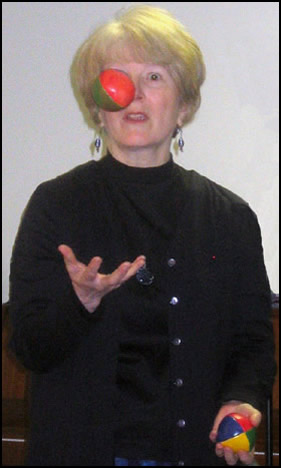
See
your spouse with a new eye.
|
KINDS OF HUMOR:
1. Engaging in fun, lighthearted past-times
together.
Examples: playing games or sports together, watching
funny movies or TV shows
Question: What are our favorite ways to
relax together and have fun?
2. Inside or
“running” jokes: Often these have
to do with personal foibles that we can turn into jokes
rather than continuing to complain.
Example: When finding something I’ve lost, I’ll
often say to Jim something like, “How clever of
you to hide my credit card back in my wallet.”
Question: What silly thing does my spouse do that
I complain about? How can I change this into a lighthearted
joke?
3. Exaggeration:
Often exaggeration of a problem or fault can turn it
into humor.
Example: Well, it could have been worse. You could have
broken your arm, never found your way back, lost your
purse AND wrecked the car.
or “Could you walk a little faster. I’m
not getting enough exercise trying to keep up.”
Question: What trait or quality do you or your spouse
have in excess? Play with ridiculous exaggerations of
how that could be a boon for your marriage or society
if it were multiplied 10 times.
4. Hindsight stories (laughing
at yourselves)
Example: Once Jim and I had to wake our 13 year old
at midnight to help us take our bedroom door off the
hinges because we had locked ourselves INSIDE our bedroom.
Question: What’s your favorite story of a
marriage or family mishap that, looking back, you can
now laugh at?
5. Pranks/Surprises:
These can backfire. Be careful.
Example: “Honey, the babysitter just called and
said she had to cancel for tonight. I’m afraid
we’ll have to cancel our dinner reservations for
our anniversary. Maybe we could just put the baby in
the car and take a leisurely drive in the country. He’ll
fall asleep and we can talk.” You then drive to
a relative’s house who agreed to watch the baby
for the weekend while you have a get-away at a resort
(or even at home).
Question: Have you ever tried a prank or surprise
that backfired? Now you have a hindsight story to laugh
about.
WHEN HUMOR HURTS:
Not all humor is funny to a spouse. Be careful about
making fun of your spouse’s weight, haircut, pregnancy,
or making fun of your spouse in front of others or behind
his/her back.
Example: It’s tempting when out with the guys
or gals to join in a round of “Can you believe
that “x” tried to put air in the car tires
by blowing into the tire valve!”
Question: What topic is my spouse sensitive about
and I should avoid? Check it out.
BACK
TO TOP
For Parents
Bless
Your Child Today
"God bless you"
is not just for sneezes. Bless your child today. If
you think blessings can only come from ordained ministers
consider yourself the “minister of parenthood.”
Blessings can take many forms but the most natural (and
simplest) one for ministers of the home are not formal
prayers but prayers from the heart. Perhaps use the
simple: “May God bless you in the name of the
Father, and of the Son, and of the Holy Spirit.”
You can add other spontaneous prayers for your child
if you like. Adding a gesture like the sign of the cross
or placing your hand on your child’s head emphasizes
the sacredness of the time. Short rituals like this
benefit from repetition. Blessing on a regular basis
carries memories of past times and brings a moment of
peace between you. Following are some times that you
might want to bless your child.
Bedtime:
Even infants can be blessed as you put them down to
sleep. In fact, blessing an infant may be more a prayer
for the parent’s peace of mind than the child
and it gives you practice. It can be a soothing conclusion
to your bedtime prayer with toddlers and young children.
Sometimes it may be the whole prayer. Older children
may resist a bedtime prayer with you but sometimes simply
putting your hand on your child’s head and silently
blessing them will avoid awkwardness. Or let a bedtime
kiss carry the message, “I love you and so does
God.”
Leaving the house:
It may be a bit much for most families, but if you start
the practice when your child first starts school, a
“God bless you in school today.” can become
part of your leave-taking.
Sickness:
A natural and welcome time to bless your child is at
a time of sickness as you add a spontaneous prayer for
the child’s recovery.
Times of crisis or
transition:
A big test is coming up, it’s the day of tryouts
for the basketball team, the day of your teen’s
drivers test, or your young adult is leaving for college.
It’s not magic, but praying for God’s blessing
can remind your child that you are carrying him or her
in prayer during this special time and they can call
on God’s aid in times of stress or difficulty.
And don’t forget those
sneezes.
BACK
TO TOP
For Couples
VALUES
& SPIRITUALITY IN MARRIAGE
Marriage is a value laden
and spiritual undertaking – even for those who
are not members of an organized religion. If your faith
is important to you, however, the marriage vows take
on a special dimension as your commitment to each other
becomes an expression of your faith, not only in each
other but also in God.
Following is an exercise
to help you identify your most deeply held values and
to check how closely they match up with your daily life.
Sometimes we believe we believe something, but how we
spend our time and money puts a lie to it. To have a
happy marriage, couples need not share every interest
BUT, it is crucial that they are in sync with their
most deeply held values. If these values are generous,
loving, and life-giving, a spiritual bonding will grow.
Directions:
Each partner takes time to reflect on the following
questions and write your answers on paper. Read each
other’s thoughts, then discuss. Since this is
a heavy topic, you might not want to do this exercise
all in one sitting, but rather take a question a day,
a week, or a month.
1. What's most important
in life to you?
(This question is intentionally open
ended to let your mind roam over all the possibilities.)
A.
B.
C.
What kind of time and money
do you put toward these priorities?
2. Covenant
Reflect on when your relationship has not always been
"fair" or equal. When has one of you been
called to give more than your fair share? (For example:
unequal schooling, incomes, physical abilities, illness…)
3. Unconditional
Is there any way that one or both of you have changed
since your wedding day that's been hard to accept?
Is there any change that
would jeopardize your love? (for example: a change in
appearance, personality, or mental health, infertility,
loss of a job, infidelity…)
4. Fidelity/Permanence
Fidelity is more than just sexual, permanence is more
than just not getting a divorce. What daily or frequent
habits have you developed to nurture your relationship?
(For example: eating together, a daily walk, checking
in by phone or e-mail, praying together…)
Has there ever been a crisis
in your relationship when you have been tempted to give
up on it? What helped you through it?
5. Fruitfulness
Has your love stretched you beyond yourselves? How?
(For example: volunteer work, service projects, helping
out in your neighborhood and community…)
For those who have a child(ren)
- How has your child stretched you to go beyond yourselves?
6. Forgiveness
Do you generally find it easy or difficult to forgive
your spouse or yourself for shortcomings and mistakes?
What has been a hard thing for you to forgive so far
in your marriage?
What does forgiveness look like in your marriage? For
example: Do you say, “Please forgive me.”
and “I forgive you.”? Do you make amends?
Do a favor? Hug? Give flowers? Make a bowl of popcorn?...
7. Prayer
How do you feel about praying? (Neutral? Curious? Inexperienced?
Committed?…)
Do you want to pray?
Do you want to try praying with your spouse?
How do you feel about praying with my spouse? (Nervous?
Embarrassed? Wistful?…)
Do any of the following styles of prayer appeal to you?
____ memorized prayers
____ reading inspirational books
____ meditation - (open)
____ guided meditation
____ prayer services/rituals
____ rosary
____ scripture reading
____ inspiration from nature
____ I'm a crisis prayer
____ other
For
ideas and a jump start on praying as a couple read
Who Me? Pray with Her?
BACK
TO TOP
ADVENT
WAITING 1
WAITING
WITH MARY – PREPARING WITH JOHN THE BAPTIST
Isaiah
40:1-11; 2 Peter 3:8-15; Mark 1:1-8
We wait for
the mail, for the rain to stop (or start), for our birthday,
for a loved one to return home, for results of a medical
test, for a trip to start, or a wedding day. It’s
hard to wait. And it should be so because waiting is
part of the experience. If everyday was your birthday
at first this would seem wonderful but eventually you
would find the thrill diminished as a special day becomes
everyday. If the rain stopped or started at your command
at first it would seem idyllic and convenient, but part
of the joy of beautiful days is knowing that they are
not always that way. We need to pay attention and savor
it. If we never had to wait for a loved one to return,
would the arrival be so cherished? Would the wedding
day carry such power if couples did not have to wait
for it?
But our culture tries to
rob us of the joy that comes from waiting – especially
during Advent. Stores celebrate Christmas before its
time and many of us are sucked into celebrating Christmas
with parties and festive homes before the actual feast.
Perhaps we need to take our lead from pregnant women.
In the quiet, dark womb, growth is taking place both
physically and emotionally. The mother starts to change
her habits and mindset. For the reflective mother, there
is also spiritual growth as slowly she lets go of control
over her body and her desires and realizes that motherhood
is a long process of sacrificing self for the good of
another. But this waiting is not only internal. Responsible
parents prepare the home. We buy baby supplies, prepare
a space, and perhaps prepare siblings for the upcoming
birth.
So too, it can be with Christmas.
As the pregnant world waits for Jesus to come again
into our midst, we need quiet, dark, internal growth,
but that doesn’t mean we need be inactive. Preparing
the home gradually; buying gifts so that we will be
ready; keeping it simple lest stress crowd out our calm
are part of active waiting. Yes, waiting is hard, but
it makes the longed for event more momentous. Let the
first day of Christmas be truly the first day of Christmas
and not just the last day of the Christmas shopping
season. Let us wait.
Some questions for
your reflection/discussion:
1. When has it been hard for you to wait for something
good?
(For example: a birthday, the results
of a test, a driver’s license, graduation, a vacation,
retirement, a letter or package in the mail, a visit
from a friend, your wedding day, pregnancy. Parents
might also include waiting for a child to walk, talk,
stop fighting, grow up, leave home, come home, get over
an illness…)
2. Is there anything I need
to let go of to make room for Christ to live in me?
(For example: anger, worries, fears,
pride, a person I’m upset with, a grudge)
3. One step that I could
take to simplify my Christmas preparations and gift
giving is…
4. In addition to my immediate
family, is there anyone that I could go out of my way
to bring joy to or lessen the burdens of during Advent?
This
meditation by Susan Vogt is also published in “Whose
Birthday Is It, Anyway? – 2005”
published by Alternatives for Simple Living, www.SimpleLiving.org
BACK
TO TOP
For
Couples or Parents
THE
GOLDEN RULE - REVISED
Have you ever gotten a gift
that just wasn’t you? Once I sent my husband flowers
as a sign of my love. I was proud of myself because
I realized what a nice surprise it is for me when he
has done that and I wanted to please him. I also thought,
“Why should flowers be reserved just for females?
Certainly men would enjoy them too.” Wrong! He
was gracious, of course, but the quizzical look on his
face told me that he didn’t quite get it, and
I learned a lesson. I was trying to give him a gift
that I wanted to receive, not what he wanted
to receive.
This got me to thinking about the Golden Rule, “Always
treat others as you would like them to treat you.”
(Mt. 7:12) Certainly this is a generous maxim and helps
us treat others fairly – as we would like to be
treated. But are there times when the Christian might
go beyond the Golden Rule to an even deeper selflessness?
What if we revised the text to say, “Treat others
as they would like to be treated.”
Getting into another’s head and searching for
what would bring them pleasure, even though it might
not be what I would want,
takes quite a love.
For example, my son had a bad day at school –
forgot his homework, got laughed at for a mistake, etc.
My inclination was to talk it through with him. “How
do you feel? Is there anything I can do to help you?”
etc. His silence was off putting at first. After all,
I was trying to give him what I would want. It took
me awhile to understand that in this kind of situation
he usually just wants to be alone, to escape into his
head or a game. What I could do to help, was leave!
On a marital level this sometimes plays out at times
when I am feeling a lot of stress – usually from
having too much to do in too short a time. Jim, being
the sensitive husband that he is, rushes in to console
me. He hugs me, holds me, kisses me. Unfortunately,
I’m afraid I’m not always too grateful.
What I really want is for someone to do some of my work!
Over time he has learned that he’ll get a lot
further if he offers to take some of my chores off my
hands. The hugging can come later. He, on the other
hand, feels unloved if there isn’t a certain amount
of physical affection. Offering to mow the lawn just
doesn’t cut it.
It’s hard to get into the habit of thinking this
way because it doesn’t feel natural – to
me. I have to put myself in the other person’s
shoes and figure out what he or she would want. I find
myself needing to curb that urge to drop in spontaneously
on friends just because I enjoy that kind of thing.
Come to think of it, isn’t that what Christ did
when he became human – put himself in our shoes,
in our flesh.
Some Questions for
Your Reflection
1. What makes my spouse (or child) happy that would
not work for me?
2. How does my spouse (or child) like to be consoled
when facing a difficulty? Is it the same or different
from my needs?
3. When I feel angry, how do I want the people around
me to respond? Does my spouse (or child) like a different
response?
For further reading on this theme, see
The Five Love Languages by Gary Chapman.
BACK
TO TOP
For Couples & Anyone
Who Cares About Truthtelling
GOSSIP
- TO TELL THE TRUTH
The
woman behind me in church was singing beautifully…too
beautifully. She sounded like a professional singer
and wasn’t blending in. She held every note past
the point the rest of the congregation had stopped.
This annoyed me even though I knew it shouldn’t.
Of course I couldn’t say anything to her. I didn’t
even know the woman since this was a church I don't
usually attend. But, as is often the case, I thought
I’d ask Jim’s opinion on our drive home
in the privacy of our car. And then I thought about
truth. I thought about the maxim I had heard years ago
– Don’t make comments to or about others
unless it meets the following criteria:
1. Is it true?
2. Is it necessary?
3. Is it kind?
I evaluated. Yes, it was true. Although her singing
was technically proficient, it was not “group
singing”. Was it necessary that I comment on this
to my husband? Not really. Was it kind? No. So I summoned
up my resolve and realized that my urge was really an
urge to gossip and make myself superior. I thought about
all of this during the homily, which wasn’t particularly
stirring that day, so I thought it was a good use of
my time. I think God does speak to us at Mass, it’s
just not always the way the liturgists planned it.
As
I continue to think about my experience, I realize that
these three rules can probably be applied to most decisions
about whether or not to hold one’s tongue. Although
it would be best for questionable comments to pass all
three, as the homily wore on, I decided that two out
of three would be sufficient in most cases.
Yes,
the truth is always friendly, or almost always. It should
indeed be the first criteria. And sometimes it might
be necessary to deliver a message of parental or fraternal
correction that isn’t particularly kind. “Son,
the way you treated your sister was hurtful. I want
you to apologize.” There’s seldom any debate
about whether to deliver a true message that’s
kind. It may not be necessary, but it’s always
appropriate.
Then
there’s the situation of a comment that’s
kind, and would be awkward to avoid, but might not be
true, like “Yes, I really love your mother’s
cooking.” Or, “Yes, that dress makes you
look thin, darling.” These white lies, I can accept
although technically they may not be completely true.
So we’re back to trying to keep all three criteria,
but no less that two – or hold your tongue.
It’s
tempting to criticize one’s spouse in the spirit
of mutual improvement. Children often criticize, and
make fun of others. So do their parents. Check yourself
against these 3 criteria: Is it true? Is it necessary?
Is it kind? If not, it’s probably fault finding
or gossip.
Have
you ever had an inner conflict over whether to tell
the truth?
Discuss with your spouse (or family) how each of you
feels about “white lies” and gossip.
BACK
TO TOP
LAUGHING
& LOVING WITH DAD
Adapted from Just Family Nights
YOU WILL NEED:
Option 1: Dad’s or Grandpa’s old clothes,
hats, shoes, ties…
Option 2: several puppets
Option 3: family picture albums
OPENING:
Light a candle and think of your own father, grandfather
or great-grandfather if you can remember them. Think
of what qualities these fathers have that you admire.
Also, are there “fathers” that are not related
to you that you think do a very good job of parenting?
Quietly think about these special men.
PRESENTATION OF THEME:
Fathers come in many shapes, sizes, and kinds. Most
fathers are good and loving to their children, but like
all humans, no father is completely perfect. Tonight
we're going to poke some good hearted fun at fathers
and in the process we might even understand fatherhood
a little better.
READING:
Luke 11: 11-13 or Luke 15: 11-32
FAMILY RESPONSE/ACTIVITY:
Choose one or more of the following activities.
1. Imitating Dad
Everyone but Dad dresses up in the "Dad type"
clothes that have been collected. Dad is the audience
and his main job is to laugh heartily, clap loudly,
and enjoy everything. Everyone else pretends that they
are "Dad" and exaggerate his mannerisms and
expressions. The only rule is that the acting must not
be hurtful or bothersome to Dad.) When the frivolity
dies down, close by each person completing the sentence,
"If I were really a father the most important thing
I would do (or be) is ____________________________________."
2. Dad: Leading Man
Everyone in the family but Dad thinks of a significant
event in the family's life in which Dad had a major
role. It could be something serious in which Dad was
a protector or hero, or it could be something funny
like a foolish thing he did. Once everyone has his or
her event in mind, use puppets to act out the situation
for Dad.
3. Where’s Dad?
Pull out the family's picture albums. Everybody makes
a guess as to how many times "Dad" is in an
album. Then play "Where's Dad" by finding
and counting how many times Dad appears. Encourage lingering
over pages that remind you of stories about Dad.
DISCUSSION:
After spoofing Dad awhile, discuss some of the following
questions:
• Are the qualities typical of fathers different
from the qualities of mothers? If so, how?
• Unfortunately, not everyone has a loving father.
Their father might be dead, no longer present, or perhaps
he just doesn't know how to be a good father. How can
people in these situations learn to be good fathers
themselves?
• How are fathers portrayed in the media? Realistically?
Stereotypically?
• Not all fathers are the same. What would a father's
life be like if he were a single parent? a step-father?
a father with a disability? a father from a foreign
country or culture?
• Discussing grandfathers and great grandfathers
can be a great opportunity to discuss some aspects of
genealogy and a lesson in oral history from parents
about their memories, experiences, family stories and
even legends. Talk about best memories, funniest stories,
etc.
• Who are there people we know who act like a
loving father to us (uncles, grandfathers, etc.)
TREAT:
Dad's choice - whatever is his favorite dessert.
Activities
are simplified adaptations from Just Family Nights,
Susan Vogt, ed. Brethren Press, Elgin, IL: 1994. See
the original book of 60 family nights for age adaptations,
expanded reading, activities, songs, recipes, and background.
BACK
TO TOP
A
BALANCING ACT – GETTING CONTROL OF YOUR FAMILY’S
TIME
Adapted from Just Family Nights
OPENING:
The leader asks everyone to form a large circle with
lots of space on either side of you. Close your eyes.
Lift one leg and try to stay balanced for one minute.
(Everyone can count slowly together.) Half way through,
open your eyes to see if it’s any easier with
eyes open.
After the silliness dies down, gather the family around
a table and light a candle. Ask each person to think
silently about: "What are all the different activities
I'm trying to balance in my life right now?"
PRESENTATION OF THEME:
The Spring Equinox (March 21) and the Fall Equinox (September
22) are the two days of the year when daylight and darkness
are most equally balanced. Let's take some time to check
out how balanced our lives are too.
FAMILY RESPONSE/ACTIVITY:
Are we too busy?
A. Everyone makes a list of how they spend discretionary
time (time not spent sleeping, eating, at school or
work) If anyone has more than two outside activities
(sports, lessons, clubs, committees, etc.) re-evaluate
whether it is causing stress to the family system and
should be put on hold. If the family feels really stressed,
just pruning out unnecessary activities to allow relaxed,
"empty" time at home may be the goal. If,
however, it's been awhile since the family has had some
fun together, share your enjoyable family activities
and decide one you'd like to do today or soon. Schedule
it. Do it.
B. Ask each person to name
an activity they really enjoy doing by themselves and
one they enjoy doing with the family.
CLOSING:
Sing "Day by Day" from Godspell.
TREAT:
Anything that comes in two equal parts (sandwich, cookies,
popsicles) or can be divided in half and shared. (That's
almost anything.)
Related scripture: Ecclesiastes
3:1-8
Activities
are simplified adaptations from Just Family Nights,
Susan Vogt, ed. Brethren Press, Elgin, IL: 1994. See
the original book of 60 family nights for age adaptations,
expanded reading, activities, songs, recipes, and background.
BACK
TO TOP
For
Couples
BONDING AS A COUPLE - SHARING FEELINGS
One way that couples develop
closeness is to share their feelings (not just their
opinions and plans but also their emotions) with each
other. Often sharing on this level comes more easily
to one spouse than the other. Following is a way to
get in touch with what each other really cares about
and what joys and burdens your spouse is carrying. It
doesn’t require much time (maybe 10-15 minutes).
The only supplies needed are a small piece of paper
and pencil. You can do it almost anywhere. Here’s
how it works:
1. Each spouse writes
down 5-10 current or recent feelings they’ve had
(in the last 24 hours). For example:
• “Relieved” (that I met my deadline
at work)
• “Worried” (because one of our children
had a bad day at school)
• “Pleased” (that you agreed to do
this sharing time with me)
• “Frustrated” (because I couldn’t
get rid of a computer virus today)
• “Weary” (of picking up after everyone
in the house)
• “Joyous” (looking forward to a free
weekend)
2. One partner starts by sharing a feeling and
what prompted it. Be brief. This is not a time
for discussion.
3. Alternate. The other partner picks
a feeling to share and why until both are finished.
Caution:
This is not a time for discussion or solving problems,
but rather simply listening and trying to understand
what’s going on inside your spouse. If couples
try to problem solve or get into extensive discussion
about negative feelings, it can inhibit you from returning
frequently to this practice. It is meant as a quick
check in. Certainly if this exercise brings up an issue
that needs further discussion, plan a separate time
to address the issue.
Some couples do this daily. Weekly is nice. Some just
do it when they’ve been feeling distant or disconnected.
This is a no guilt plan to deepen your love.
Adapted from the SHARING TIME concept
developed by David and Vera Mace of ACME (Association
of Couples in Marriage Enrichment)
BACK
TO TOP
For
Couples
SHARING DREAMS / MAKING THEM COME TRUE
1.
A dream that I have for our future is...
(This could be a fantasy that you
don't really expect to come true but enjoy dreaming
about, or it could be a hope that you’re committed
to making come true. Either can revitalize your relationship.)
2.
Five years from now I imagine that our life together
will be different in the following ways:
(Consider things like having a child, having fewer
children at home, different jobs, different home...)
3.
Write a one or two sentence description of your commitment
to your spouse.
(This might reflect a resolution you've made or
it may simply be a statement of your love for your spouse
put in your own words.)
BACK
TO TOP
For
Families
ADVENT
WAITING 2
Adapted
from Just Family Nights
NOTE:
Although Advent is clearly a Christian season of preparing
for the birth of Jesus, Non-Christians may choose to
focus on "waiting" as a self-discipline which
helps the family appreciate the value of delayed gratification
and simplifying our lifestyle. Alternatively, Jewish
families may find many of the concepts below applicable
to preparing for Hanukkah.
BACKGROUND:
The Christmas season is already loaded (or overloaded)
with activity and traditions in most American families.
Our consumer culture has so appropriated this feast
that even families that have no particular religious
reason for celebrating Christmas, get very caught up
in buying and festivities. Celebrating in itself is
not bad but in the process of starting the Christmas
season earlier and earlier (in order to encourage "shopping
days") Christians often lose sight of the value
of Advent – the season of waiting and preparing
for the birth of Jesus. Even families who are not Christian,
but share the season's values of bringing peace and
care to our neighbors and our world yearn for a return
to a simpler season. For these reasons this Family Night
focuses on reassessing our Christmas activities and
trying to return Advent to its original spirit.
It is our assumption that most families already have
a plethora of customs and the need is not so much to
offer additional ones as to prune away burdensome ones
and bring the focus back to a quiet "waiting"
in the dark of the winter solstice for the light of
Christ to be reborn.
In the following family night I suggest several customs
that help measure the "waiting time" such
as the Advent Wreath, Advent Calendar, and Advent Chain.
Use even these, however, with discretion, since the
primary goal is to unclutter this pre-Christmas season
in order to reclaim its true meaning.
Some families make it a point to write Christmas cards,
do Christmas tree decorating, parties and gift exchanges
only on, or after, December 25. This is a laudable goal
but must be balanced by the awareness that tampering
with family traditions can be a risky business. If it's
going to cause dissension or tension, better to be less
pure but happy with each other during this season. Likewise,
reducing and simplifying gift giving is also a worthy
goal, but must be balanced by sensitivity to the feelings
of those with whom we exchange gifts.
For those unfamiliar with the symbolism of the Advent
wreath:
1. The circle is a reminder of eternity - never ending.
2. The evergreens are a reminder of life that continues.
3. The four candles stand for the four weeks of Advent.
Purple candles are lit the first two weeks. A pink candle
is added the third week to symbolize a joyful break
in the solemn waiting. The third purple candle is added
the final week.
Thus, visually the family sees the gradual increase
in light as we move closer to the feast of Christmas.
YOU
WILL NEED:
Advent Wreath (If the family does not already have an
Advent Wreath buy or make one by using three purple
candles and one pink candle surrounded by evergreens
shaped in a circle)
Watch with a second hand for leader
Large piece of paper
OPTIONAL:
Advent Calendar
1" x 6" strips of construction paper
Creche figures
OPENING:
Assuming this Family Night is being done the first week
of Advent have the oldest child light the first candle
of the Advent Wreath. All sing the chorus to "O
Come, Emmanuel". If the family does not have the
custom of using the Advent Wreath, explain its meaning
(see background.) Then, without explaining why, the
leader waits and does absolutely nothing for exactly
one minute.
PRESENTATION
OF THEME:
First debrief with the family what it felt like to have
to wait: doing nothing, for one minute without knowing
fully why or how long this would go on. Was there frustration,
anger, silliness? Did people feel "antsy"?
In its truest sense Advent is a time of active waiting
for the birth of Jesus. This doesn't mean that we sit
around and do nothing for the four weeks before Christmas
but rather that we spend our time quietly preparing
for this holy day. This is in stark contrast to our
culture which hurries Christmas (and most holidays)
by not only preparing for it but also celebrating it
before its actual time.
READING:
Luke 1:26-45
OR
"The $32 billion people in the U. S. spent last
year on Christmas gifts does not include the larger
costs of Christmas. Christmas has a great impact upon
the environment. Consider the waste disposal costs of
this spending binge, or the long-term costs of using
irreplaceable natural resources for non-necessity commodities.
A drive down the street on the first trash pick-up day
after Christmas is a sobering reminder of the amount
of waste generated in this celebration. Behind every
pound of garbage at curbside, there are approximately
20 pounds of industrial or agricultural waste created
in the process of production." from
Looking Behind the Cost of Christmas. Milo
Thornberry.
Alternatives, P.O. Box 429, Ellenwood, GA 30049 (404)961-0102
FAMILY
RESPONSE/ACTIVITY:
Tonight we're going to focus on how our family can keep
the true spirit of Advent by learning to get better
at waiting and by rethinking our Advent and Christmas
customs so that they are in harmony with the Christmas
spirit of peacefulness, stewardship and simplicity.
1.
On a large sheet of paper have the family list all the
usual activities and customs your family does before
and after Christmas. (Examples: get Christmas tree,
decorate it, buy presents, bake cookies, put up lights,
send Christmas cards, use Advent Wreath, get out creche
scene, decorate house, have parties, exchange gifts,
etc.)
2.
Go through the list and distinguish which activities
are truly preparing (i.e. making, buying presents) and
which are more celebrating (i.e. exchanging presents,
parties) Mark a "P" next to preparing activities
and a "C" next to celebrating activities.
3.
Go through the list again assessing the timing of the
activities. Does anyone in your family feel stressed,
overly busy, or hectic during Advent? If so, can you
adjust some of your customs so that they are more consistent
with a peaceful season of waiting?
A. Consider spacing the preparing activities so that
they gradually and humanely build toward Christmas.
(i.e. First week set up the Advent Wreath, second week
set up the creche scene, third week get Christmas tree,
fourth week do preliminary decorating.)
B. Are there any activities that you usually do during
Advent that really are celebrating activities? Could
you wait till Christmas Day or during the 12 days of
Christmas to do these? Are there even preparing activities
that you could wait to do until closer to Christmas?
(Example: wait to decorate the tree and put up stockings
until Christmas Eve.)
C. Are there some activities that you do out of habit
or duty that may be OK but add undue burden during Advent?
(Example: Do you bake out of obligation or out of love?)
Can you agree to eliminate any activities?
4.
Go through the list again and note whether there are
any activities that serve people in need or contribute
to peace in our world. If not, discuss how your family
can share your resources with those who have less as
a way of being faithful to the true spirit of Christmas.
(Examples: make a significant donation to a charity,
provide gifts for a family in need, go Christmas caroling
at a nursing home, etc. Most churches and organizations
offer plenty of opportunities for service at this time
of year.)
5.
Can you all live with your family decisions? Post them
in a prominent place in the house. If desired, the family
can make the list more "artful" by putting
a big star or Christmas tree in the middle of a large
piece of paper with one side labeled "preparing"
and the other "celebrating" and list appropriate
activities on each side. Children could decorate the
chart.
6.
Choose one or more of the following activities that
can help the family measure this time of waiting.
A. The opening Advent Wreath ritual itself may be sufficient
since each week an additional candle is lit.
B. Make or purchase Advent Calendar(s) so that a window
can be opened each day.
C. Make an Advent Chain by cutting 1" x 6"
strips of multi-colored construction paper. Each night
at dinner each person puts the name of a person or cause
for which they want to pray on a strip. Staple together
each day. By Christmas there is a chain of prayers to
decorate the tree.
D. Invite children to add a piece of straw to the manger
each time they do a good deed.
E. Ceremoniously unwrap each creche figure and together
set up the creche scene in a place of honor.
TREAT:
Something easy to prepare - no waiting; cookies, ice
cream, etc.
Activities
are simplified adaptations from Just Family Nights.
Susan Vogt, ed. Brethren Press, Elgin, IL: 1994. See
the original book of 60 family nights for age adaptations,
expanded reading, activities, songs, recipes, and background.
BACK
TO TOP
For Couples
WHEN
WE DISAGREE
Unless
one spouse is exceedingly passive or afraid to displease
his/her partner, married couples will have disagreements.
This is not bad; it is an expression of self-differentiation
and identity. The challenge is to make these times of
disagreement – emotionally difficult as they sometimes
are – times of growth, not undue hurt.
Following
are five ways to approach your next disagreement. I
call them the “5 C”s”
1. Concede
Although you may not be willing to “just give
in” when you both feel emotionally involved in
an argument, this works when one partner is NOT strongly
committed to a position and it is more of a preference.
For the sake of family harmony you might decide to freely
bend your will to let your partner have his/her way
this time. The conceder must be willing to not harbor
resentment. For example, although both of you may want
to visit your own relatives over Christmas, maybe it
is more important to go to your spouse’s family
this year because of a recent death in the family.
2.
Compromise
This classic negotiation format is well known but often
neglected in the heat of anger. Each mate gives up something
for the sake of the relationship. For example, I’ll
come and watch your softball game this week if you’ll
join me in some recreation I enjoy (maybe a book club)
next week.
3.
Chance
Sometimes ways to compromise or take turns are not obvious
or practical. If an evening of recreation cannot be
split, you might just flip a coin, pick lots, etc. The
key is for the loser to practice the self-discipline
of gracefully letting go of his/her preference and not
sabotage the decision by holding a grudge while ostensibly
agreeing to it.
4.
Co-Existence
When neither partner is willing to accede to the spouse's
wish (even part-way or for a time) agreeing to disagree
may be the best solution. Spouses keep their own opinion
or desire and allow the other to do the same. This works
when the decision is relatively minor or there is not
enough time to fully explore options. Caution: Co-Existence
is not appropriate when one spouse’s decision
interferes with the partner’s freedom to decide.
For example, couples cannot agree to disagree on whether
to have a child, whether one should stop working, whether
to move, etc. Life values and moral questions that impact
each other must be resolved mutually.
5.
Create a New Possibility
Spouses work together to brainstorm new options that
neither one had thought of previously. This takes some
energy and creativity but often is the most life giving
option. Example: Instead of choosing whose relatives
to visit at Christmas, invite everyone to your home,
meet at a cabin in the woods, hold a videoconference,
etc.
Which
one is best?
One way to know which of these options to use is for
spouses to independently rank how strongly they feel
about getting their way on a scale of 1 – 10 (1
being, I don’t much care to 10 being
grounds for separate bedrooms)
If
one spouse is close to 10 (feels extremely strongly
on the issue) and the other is closer to 1 (doesn’t
much care) Conceding would be the gracious way to go.
(The only exception to this is if there is a pattern
where the same spouse consistently is at 9 or 10. This
is just manipulation or selfishness and needs to be
confronted.)
If
both of you are near the middle (4, 5, 6) consider Compromise
or Chance.
If
both of you feel strongly (7, 8, 9, 10) consider Co-Existing
or Creating a New Possibility.
If
neither of you care much (1, 2, 3) then you probably
aren’t having an argument.
Consensus
Consensus is an additional option available to groups
trying to come to a decision when there are conflicting
opinions. After all sides of an issue have been aired
and dissenting views heard, the leader takes a sense
of the group and suggests the direction that seems to
have emerged with the most support. Although it may
not be everyone’s first choice or preferred way
to go, if everyone can live with the proposed decision
without serious reservations, a consensus is declared
in order to let the group move forward. If there ARE
still serious reservations the group continues to talk
and test compromises until consensus can be reached.
This
model is adapted from the Growth in Marriage for Newlyweds
program developed by Family & Children Services
of Kansas City and the Association of Couples for Marriage
Enrichment (ACME).
BACK
TO TOP
For Families
LIFE
& DEATH
Adapted
from Just Family Nights
YOU
WILL NEED:
Balloons
Pin
OPENING:
Light a candle and ask each member to take a moment
to silently think about a relative, friend, or pet that
has recently died. Think about the good they did and
the joy they brought to us when they were alive.
PRESENTATION
OF THEME:
If this is done near Halloween, the leader may explain
that the custom of Halloween is connected with the Christian
feast of All Saints' Day. Halloween, or "Holy Eve"
was the night before we remember the saints who have
died.
If
this is done upon the death of a relative, friend, or
beloved pet, merely comment that we are gathering to
remember our love for ___________and to share our sadness
now that s/he has died.
FAMILY
RESPONSE/ACTIVITY
Blow up the balloon and play with it for awhile. Talk
about how fun it is and what color it is and how much
we like it. Then pop the balloon. You are left with
the physical shell, but the life, the fun, is gone with
the air. The air from the balloon, however, is still
in the room with us. When a person dies, we believe
that his or her spirit is still with us. The body is
dead and will be buried, but as long as we remember
the person, part of them, like the air, is still with
us even if we can't see them anymore.
If
it is a small pet that has died, hold a simple burial.
Dig a hole in a corner of the yard, wrap the pet in
tissue and place it in the hole. Before covering the
pet with dirt, the leader invites everyone to say how
the pet brought joy to our life and how much we loved
the pet. If desired, a spontaneous prayer might be said
asking God's blessing on the pet and on us in our sadness
over our loss. Cover the hole and give comfort to each
other.
TREAT:
Depending on the nature of the occasion, the family
may not be in the mood for a festive treat. If the death
is not a recent one, however, and the family is in the
mood, a bunch of balloons could be blown up to play
with. Hollow candy or puff pastry might also be fun.
Related
Scripture if desired: John 12:24
This
activity is simplified from Just Family Nights.
Susan Vogt, ed. Brethren Press, Elgin, IL: 1994.
See the original book of 60 family nights for age adaptations,
expanded reading, activities, songs, recipes, and background.
BACK
TO TOP
For Couples
HOW
DO I KNOW THEE ?
LET ME COUNT THE WAYS
Please
answer the following questions separately, then compare
and discuss.
Be honest!
| 1.
How much money would I spend without consulting
my spouse first?_____ |
| 2.
If I could buy anything, what would it be? |
My
spouse? |
| 3. What
is my favorite place to go out to eat? |
My spouse’s? |
| 4. If
I could vacation anywhere on earth, where would
it be? |
My spouse’s? |
| 5. What
is my favorite movie? |
My spouse’s? |
| 6. What
is my favorite reading material or book? |
My
spouse’s? |
| 7. What
is my favorite time of day? |
My spouse’s? |
| 8. Where
is my favorite place to made love? |
My
spouse’s? |
| 9. What
makes me laugh? |
My spouse? |
| 10.
When is my prayer time? |
My spouse’s? |
| 11.
Household chores I despise. |
My spouse’s? |
12.
My favorite thing to wear.
| What's
my spouse say I look good in? |
| 13.
What is my spouse’s shoe size? ______ |
|
| 14.
What do I think we disagree about the most? |
What
does my spouse think? |
| 15.
What is my favorite “pig out” food?
|
My spouse’s? |
| 16.
What is my favorite leisure activity? |
My spouse’s? |
| 17.
My favorite expression is… |
My spouse’s? |
| 18.
Do we make love enough? _____ |
What
would my spouse say? ____ |
BACK
TO TOP
For
Families
FORGIVE
& FORGET
Adapted from Just Family Nights
YOU
WILL NEED:
A hand puppet for each person in the family (socks with
buttons for eyes can substitute)
OPENING:
Light a candle while each family member silently thinks
about "What do I generally get most mad about in
our family? With whom do I fight the most?"
PRESENTATION
OF THEME:
Most people don’t have much trouble starting an
argument. We want to get better at stopping them. Anytime
people live closely together and lead a common life,
there are going to be differences - different personalities,
different opinions, and different ways of doing things.
The problem comes when we let a fight or argument cause
hurt - either physical hurt or hurt feelings. Let’s
get better at fighting and forgiving tonight.
FAMILY
RESPONSE/ACTIVITY:
What’s the beef?
Thinks of a recent time you felt angry with another
member of your family and maybe got into a fight. Invite
everyone to let their puppet act out the situation using
their own puppet and the puppet of the other person.
It's OK to exaggerate the conflict a little for drama
and humor's sake.
Solving
the beef
After everyone has had a chance to act out their "beef",
it's time to solve the beef. The leader asks for suggestions
for the family's Rules For Fighting. List them on a
large sheet of paper. The list may include such things
as:
1. No name calling.
2. No hitting.
3. If two people want the same thing and only one can
have it, toss a coin or pick numbers. (The person closer
to the parent's number gets it.)
4. What are some agreed upon consequences that will
happen when familiar fights erupt (i.e. no TV, time
out, go to different rooms, no one gets it, etc.)
5. Add your own.
Display
the list in a prominent place.
Finishing
the beef
Invite everyone to use their puppets to replay their
fight of a few minutes ago using the RULES FOR FIGHTING
to get to a satisfactory resolution.
Forgiving
the beef
At the end of each pair's skit, the two members take
off their puppets and the leader asks if they feel they
can ask for and offer forgiveness. Complete with a hug.
NOTE
TO LEADER: "I'm sorry that you feel hurt"
can be used if someone believes a problem is not their
fault. Also, "I'm sorry" should not be forced
or required, but only encouraged, since it must be genuine
to be believed and effective. If a member is not ready
to ask or offer forgiveness, merely accept this reality
and express the hope that time will heal the hurt.
To
close, the whole family stands in a circle, takes two
steps toward the middle of the circle and has a "family
hug".
TREAT:
Try "eating your words". Take Alphabits cereal,
spell out any angry feelings you might have had and
"eat" them to get rid of them.
Related
Scripture if desired: Matthew 18:21-35
This
activity is simplified from Just Family Nights.
Susan Vogt, ed. Brethren Press, Elgin, IL: 1994.
See the original book of 60 family nights for age adaptations,
expanded reading, activities, songs, recipes, and background.
BACK
TO TOP
For
Couples
COMMUNICATION
CHECK-UP
1.
What are the feelings that I find most difficult to
express to my spouse?
(For example: inadequacy, jealousy, fear, anger, failure,
praise, tenderness, etc.) Why?
2.
Is one of us more at ease expressing emotions while
the other is more the "thinker"? How does
this affect our communication?
3.
When I feel really angry with my partner, I usually...
4.
I really like it when my spouse shows his/her love for
me by...
5.
I would really like it if my spouse would also...
BACK
TO TOP
For
Families
WE’RE
ALL IN THIS TOGETHER
Adapted
from Just Family Nights
YOU
WILL NEED:
Map of the world or a globe to pass around.
Web of Life Game supplies: ball of string or yarn, make
8 nature cards with string to go around necks for: sun,
plants, food, water, soil, air, animals, and people
OPENING:
Light a candle and sing a song like "This Land
is Your Land".
PRESENTATION
OF THEME:
The earth we live on is like a giant living creature.
Sometimes this is called an eco-system and it means
that everything in, on, and above the earth is connected.
When one part of the system changes or is hurt this
affects other parts. Even parts of the environment that
are not generally thought of as alive like the sun,
water, or soil impact each other and all life.
FAMILY
RESPONSE/ACTIVITY:
"Web of Life" - Instructions:
Form a circle. Place one nature card on each player
(Smaller families can give more than one card to a person).
The leader is a spider in the middle of the circle and
will weave a magical web, "The web of life".
Tell the story of ecology below. Weave or pass string
from sun to plant to food to water, etc, when indicated
by the story.
THE
WEB OF LIFE:
All things on earth, living and non-living, in some
way depend on each other. This relationship is called
the balance of nature. It is the web of life.
All life depends upon the sun.
Green plants need the sun to make their own food,
Water, soil and air are also necessary.
Some animals eat plants,
Humans depend upon plants and animals for food.
humans must be aware of this balance of nature and do
their best to protect and preserve it.
Finally,
recite the Earth Pledge. The family could make a collage
of beautiful nature scenes and write the Earth Pledge
on it. This could be hung in a prominent place as a
reminder and recited periodically.
The
Earth Pledge
I promise to care for all the earth
Because of its life and awesome worth.
For land and water and plants and air,
For animals and people everywhere.
For all that lives, and all that gives
Me LIFE, I give my word.
TREAT:
Serve vegetables and dip or fresh fruit to represent
produce from the earth.
Related
Scripture if desired: Romans 12:5-6
This
activity is simplified from Just Family Nights.
Susan Vogt, ed. Brethren Press, Elgin, IL: 1994.
See the original book of 60 family nights for age adaptations,
expanded reading, activities, songs, recipes, and background.
BACK
TO TOP
For
Couples
COUPLE
FUN INVENTORY
Instructions:
Each spouse rates the following on a scale of 1-10 with
1 being the least enjoyable and 10 being the most enjoyable
kind of fun or recreation you do as a couple.
Husband/Wife
_____/_____ Visiting/hosting friends
_____/_____ Dining out together
_____/_____
Traveling together
_____/_____ Going to parties
_____/_____ Participating in sports together
_____/_____ Watching sports together
_____/_____ Romantic evenings together
_____/_____
Playing games at home
_____/_____
Sharing jokes or humor
_____/_____ Plays, concerts, movies
_____/_____
Surprising/Being surprised
_____/_____
Working together to fix things up
_____/_____
Joint service/civic/faith projects
_____/_____
Other _________________________________________
When finished, talk about each area in terms of similar
or different ratings and how you feel about your answers.
Do you want to make any changes, either as an individual
and as a couple?
How can you be more playful and have fun without "working
at it"?
Is there anything you really like to do together that
doesn't cost much or any money?
REMEMBERING FUN
OR PLAYFUL TIMES
•Recall
a humorous incident or story in your relationship that
made you laugh.
•Recall
a time in your relationship when you were surprised
by your partner.
•Remember
a time when the two of you did something unusual or
crazy.
BACK
TO TOP
For
Families
A PIECE
OF THE PIE
Adapted from Just Family Nights and a nice
complement to tax season
YOU
WILL NEED:
Dollar bill (or play money)
Match, plus a safe way to burn the money
Poker chips (or similar counters such as buttons or
pebbles)
Tripoli (or similar game that can use poker chips)
or Monopoly
Paper and crayons for younger children
OPENING:
Leader dramatically burns a dollar bill (or play money
if you can't bring yourself to destroy the real thing)
PRESENTATION
OF THEME:
NOTE TO LEADER: This session works best when there
is an element of surprise, so announce the theme simply
as "Money". In this way, the experience
itself is the teacher. For example, "Let's play
a game using pretend money, since most of us don't
have money to burn. People sometimes use poker chips
as a substitute for money in games, so that's how
we'll do it."
Prepare
to play a poker chip game like Tripoli or a cash game
like Monopoly.
If the family is not familiar with this game or a
similar one, teach the game first and perhaps do a
sample round under the normal rules.
Once
everyone understands the game, the leader distributes
the poker chips or play money making sure to allot
them unevenly. For example, the youngest child may
get the most and there should be other obvious inequalities.
It
is unlikely that the game will get very far before
a reaction from those who were dealt less chips or
money erupts. At this point the leader stops the game
to discuss the feelings of the different players.
•Why is it unfair that you didn't get as many
chips/money?
•How do those of you who got more feel?
•Did you do anything special to deserve more
chips/money?
•Who wants to keep playing?
The
leader then explains that unfortunately this unfair
distribution of money really happens in the real world.
In fact, 6% of the world's population (the equivalent
of the population of the U.S.A.) uses 40% of the world's
resources. Many people are born poor and didn't do
anything to deserve it, but have a hard time getting
money because they don't have good health, a good
education, or have a family that helps them succeed.
FAMILY
RESPONSE/ACTIVITY:
1. The family could continue to discuss why inequities
of wealth exist in our country and in our world. Do
we know anyone who has fewer material goods than us?
Is there a discreet way to help someone who currently
has a legitimate need for more money? Should our family
consider tithing our time and resources?
2. When discussion has run its course, the original
game of Tripoli or Monopoly could be restarted with
everyone getting an equal amount of chips/money.
TREAT:
Anything green or round like coins would be fitting,
perhaps green cookies or thin mints.
Related
Scripture if desired: Matthew 19:23-26
This
activity is simplified from Just Family Nights.
Susan Vogt, ed. Brethren Press, Elgin, IL: 1994.
See the original book of 60 family nights for age
adaptations, expanded reading, activities, songs,
recipes, and background.
BACK
TO TOP
For Couples
I
FEEL LOVED WHEN…
It
is particularly nice to feel loved and cared for by
one special person. It is an unrealistic expectation,
however, to think that one partner can ‘just
naturally know’ what helps the other feel especially
loved. It is a romantic myth that “If you really
loved me, you would know what I want.”
Individually
complete the following sentence:
I feel loved when ____________________ OR, I appreciate
it when _______________________
List
at least five actions or behaviors your spouse has
done that helped you feel loved or that you especially
appreciated.
1.
2.
3.
4.
5.
When
both of you have completed your responses, take turns
sharing with your spouse.
Adapted
from: Marriage Enrichment Resources by the
National Association of Catholic Family Life Ministers
(NACFLM), www.nacflm.org
Used with permission
| |
|
|
|
|







 On
our last visit to Micah, it was time to break the piggy
bank and send in his donation. This was harder than
he had anticipated. Being six, and seeing all this money
he had saved ($37) he started to think of all the toys
he could buy with the money. We watched him waver and
struggle with his decision to give it all away. His
mother wisely said it was his decision. Eventually,
with almost a tear in his eye, he said, “OK, I’m
doing it.”
On
our last visit to Micah, it was time to break the piggy
bank and send in his donation. This was harder than
he had anticipated. Being six, and seeing all this money
he had saved ($37) he started to think of all the toys
he could buy with the money. We watched him waver and
struggle with his decision to give it all away. His
mother wisely said it was his decision. Eventually,
with almost a tear in his eye, he said, “OK, I’m
doing it.”


